
Fossil is coming for your favourite microbrand.
Well, not really.
But actually, kind of.
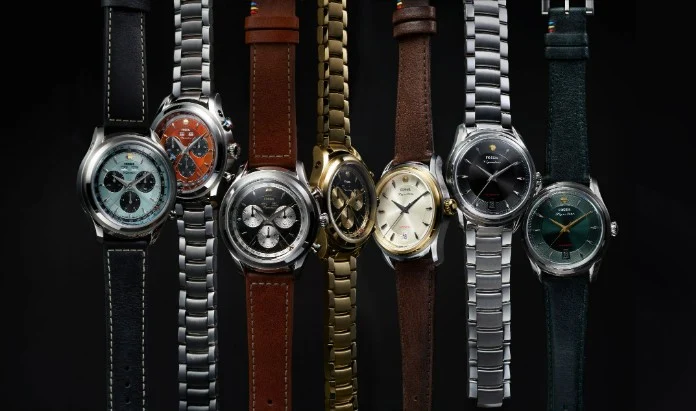
Because Fossil, yes, that Fossil, has just launched a Swiss Made automatic watch with a Sellita movement, sapphire crystal and a fairly restrained design.
And it'll cost you US$895 on a bracelet.
That's the sort of watch we've become accustomed to seeing from smaller independent brands. Except there's absolutely nothing micro about Fossil.
What's more interesting, though, is that Fossil has tried almost exactly this before.
Back in 2013, the company launched a collection of Swiss Made watches with remarkably similar specifications and, rather amusingly, an almost identical price.
Thirteen years later, the watch market is a very different place, and Fossil itself is a very different company.
So why is it going upmarket again? Can a premium Fossil convince enthusiasts to part with their money? And should established microbrands be worried?
Meet the Fossil Signature CS-1
Fossil's new collection is called the Signature CS-1, standing for Case Study One.
The name is a reference to the Case Study Houses programme, a mid-century American architectural experiment that explored new approaches to residential design.
I'll admit I wasn't particularly familiar with it, but architecture isn't really my thing.
Nevertheless, it's a reasonable source of inspiration for a collection built around restrained proportions and considered design.
The Signature CS-1 launches with two watches, each available in several configurations.
And I think there's quite a lot to like here.
The Three-Hand Date Automatic
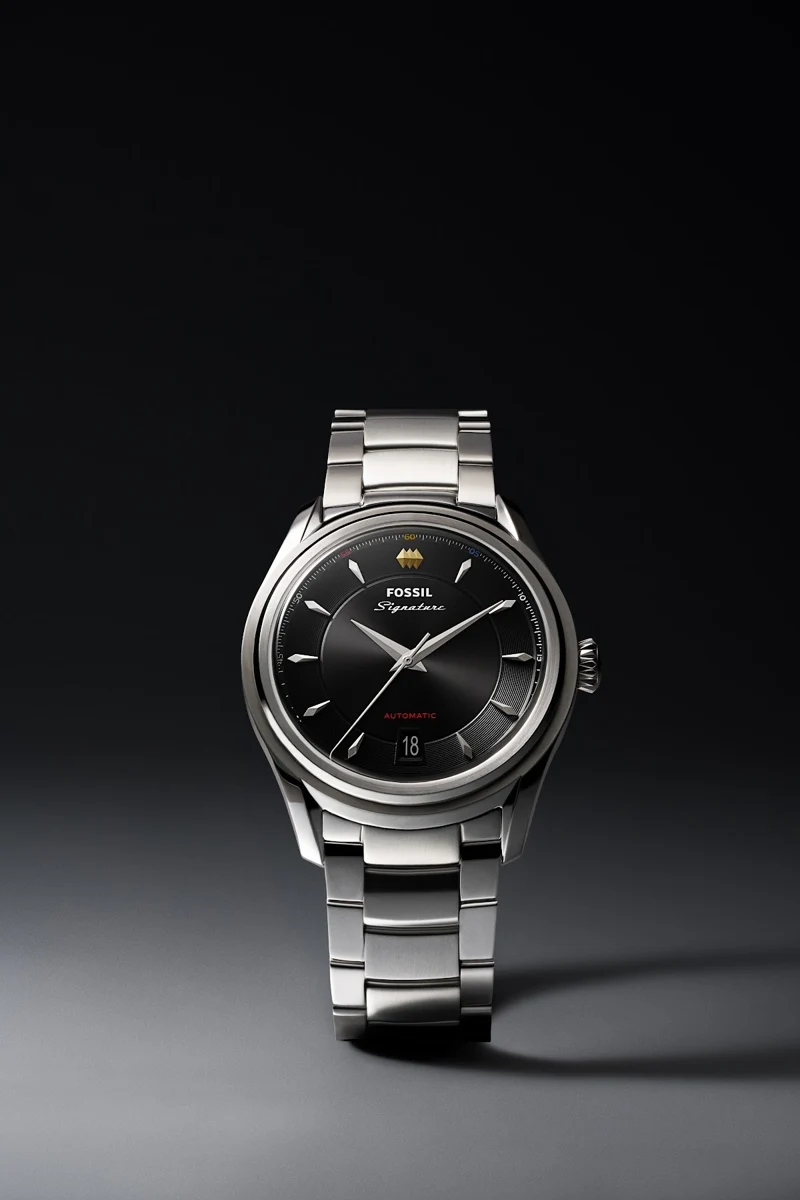
The first, and probably the more interesting from an enthusiast's perspective, is the Signature CS-1 Three-Hand Date Automatic.
Prices start at US$795 on a leather strap, increasing to US$895 on the stainless-steel bracelet.
It comes in a 38mm stainless-steel case with a domed sapphire crystal, 100 metres of water resistance and an exhibition caseback.
Inside is the Swiss Sellita SW200-1 automatic movement, complete with a customised Fossil rotor.
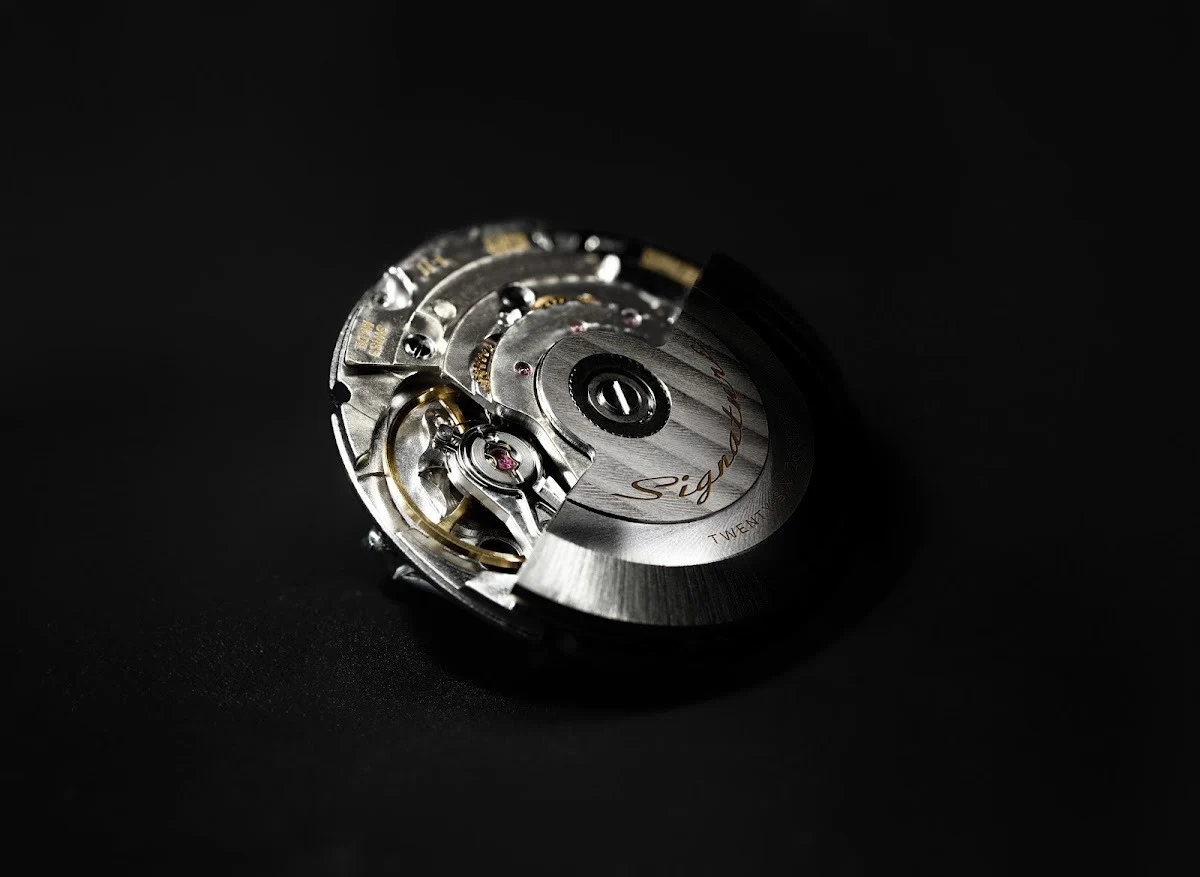
There's nothing particularly unusual about the movement, but that's not a criticism. It's a familiar, established Swiss automatic calibre that makes sense in a watch positioned at this level.
The bracelet is another interesting detail, with links designed to be adjusted without tools.
But what I like most is the dial.
It has elongated, diamond-shaped hour markers, a subtle concentric texture inspired by vinyl records, and a nicely framed date window at six o'clock.
There's a distinctive design here without Fossil feeling the need to throw every possible detail at it.
It's actually quite restrained by the brand's usual standards.
And judging purely from the photographs and specifications, I think it's a rather good-looking watch.
The Master Calendar Chronoquartz
The second watch is the Signature CS-1 Master Calendar Chronoquartz.
This one's a little larger at 42mm, starting at US$695 on leather and rising to US$795 on the bracelet.
Rather than an automatic, it uses the Swiss Ronda 5040.F quartz movement, providing a chronograph alongside day, date and month indications.
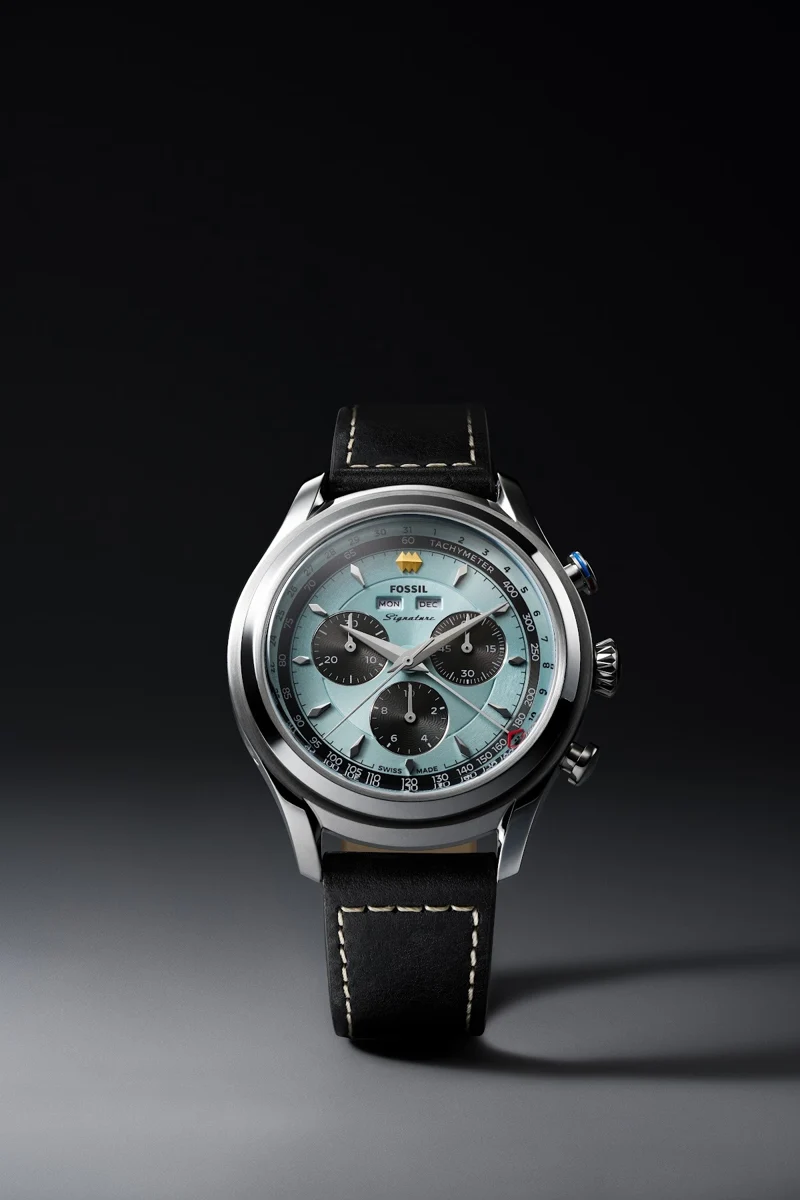
There's a central pointer date that reads against a scale around the outside of the dial, along with contrasting subdials and a rather colourful selection of configurations.
It's a considerably busier design than the automatic, but not necessarily in a bad way.
I quite like the contrasting colours and the way Fossil has organised a fair amount of information into the dial.
Although I do have one slightly peculiar complaint.
In the launch photography I was looking at, that central pointer date was surprisingly difficult to make out. It seemed to be obscured by the bezel, distorted by the crystal or simply difficult to see from the chosen angle.
It's an odd way to photograph a watch when one of its distinguishing features is a pointer-date display.
Perhaps I'm being a little picky.
Both watches feature domed sapphire crystals, and the Chronoquartz offers 50 metres of water resistance.
Importantly, they're also genuinely Swiss Made watches, not simply watches containing Swiss movements.
Fossil confirms that the collection meets the Swiss Made requirements, including assembly in Switzerland.
On paper, these are perfectly respectable efforts.
Are they extraordinary value? Not necessarily. There's an awful lot of competition at these prices.
But before looking at that competition, there's something rather interesting about Fossil's latest experiment.
Because we've seen almost exactly this watch before.
Fossil already tried this in 2013
In February 2013, Fossil launched its first Swiss Made collection under its own brand name.
And looking back at those watches today, the similarities are remarkable.
The original collection included a 38mm Swiss automatic with a sapphire crystal, exhibition caseback and a fairly restrained dial.
Sound familiar?
Here's the part I particularly enjoy.
The automatic was advertised at around US$895.
Almost exactly the same price as the new Signature CS-1 on its bracelet.
Did somebody at Fossil find an old folder labelled "Swiss Watch Project 2013" and decide it was finally time to give it another go?
Of course, once inflation is considered, the new watch is actually substantially cheaper in real terms.
But the similarities are still striking.
In some ways, Fossil's original effort was arguably even more ambitious.
Rather than sourcing an established Sellita movement, the company used the STP 1-11, a Swiss automatic calibre produced by a movement manufacturer within Fossil Group.
Fossil had acquired Swiss Technology Production in 2012, giving it its own Swiss movement manufacturing capability.
And that wasn't its only involvement in Swiss watchmaking.
Fossil had acquired Zodiac in 2001, followed by several Swiss companies involved in watch design, sourcing and production.
By 2013, Fossil Group was producing and exporting around 400,000 Swiss Made watches annually across its various brands.
That's an extraordinary amount of involvement in Swiss watchmaking for a company most enthusiasts primarily associate with affordable fashion watches.
This wasn't some half-hearted experiment involving a Swiss movement dropped into an otherwise conventional Fossil.
The company had invested real money into building the infrastructure to support its ambitions.
And its Swiss watches weren't universally dismissed either.
The response from enthusiasts was mixed, certainly, but some contemporary coverage was surprisingly positive.
Yet when I went back and read the reactions from 2013, something stood out.
The central question being asked was almost identical to the question being asked today.
Would you really spend $895 on a Fossil?
Despite the company's investment, experience and distribution network, those Swiss watches never became a permanent feature of its catalogue.
Which raises a fairly obvious question.
What happened?
From $3.5 billion to $1 billion
To understand why Fossil is trying this again, I think it's worth looking at what happened to the wider company.
In 2013, Fossil Group reported approximately US$3.26 billion in annual revenue.
That grew to around US$3.51 billion in 2014.
Fossil was an enormously successful business, selling watches, jewellery and accessories through a vast international retail and distribution network.
Then 2015 arrived.
And so did the Apple Watch.
Now, I've explored the impact of smartwatches on the traditional watch industry in my article The Connected Crisis, so I won't repeat the entire argument here.
But in short, brands such as Fossil had spent decades selling relatively affordable, fashionable wristwatches to customers who weren't necessarily enthusiasts.
For many of those customers, a watch was a practical accessory, a fashion statement, or a bit of both.
Suddenly, the Apple Watch offered an entirely different proposition.
It could tell the time, of course, but it could also provide notifications, track fitness, run applications and integrate with the phone already in your pocket.
For customers primarily interested in functionality, traditional fashion watches suddenly had a rather formidable competitor.
Fossil recognised the threat and tried to tackle it directly.
In 2015, the company acquired wearable technology business Misfit and began investing heavily in connected watches.
And to be fair, it wasn't entirely unsuccessful. Connected watches became a meaningful business for Fossil, generating substantial revenue.
But competing in smartwatches meant taking on an entirely different class of competitor.
Instead of fighting brands like Timex and Daniel Wellington for a place on someone's wrist, Fossil was now competing with companies such as Apple and Google.
For a traditional watch company, no matter how large, that's a rather difficult fight.
By 2024, Fossil had exited the smartwatch category.
And while smartwatches were far from the only reason for the company's difficulties, the broader financial decline was dramatic.
| Financial year | Fossil Group annual revenue |
|---|---|
| 2013 | US$3.26 billion |
| 2014 | US$3.51 billion |
| 2025 | US$1.00 billion |
These are Fossil Group revenues, not sales of Fossil-branded watches alone.
The decline reflects more than the arrival of the Apple Watch. Changing consumer preferences, competition, distribution changes and Fossil's own business decisions all played a part.
Nevertheless, the contrast is striking.
The group that generated more than $3.5 billion in 2014 had fallen to approximately $1 billion in annual sales by 2025.
And here's another interesting detail.
As part of its restructuring, Fossil closed its Swiss manufacturing operations in 2024.
So the company that had once invested heavily in manufacturing its own Swiss movements was now moving away from that part of the business as well.
Yet in 2026, Fossil is introducing Swiss Made watches again, this time using established Swiss movements and working with Swiss partners.
From the outside, it might look like a company that can't quite decide what it wants to be.
But I think there's actually a fairly sensible strategy behind all of this.
Fossil wants to be a more premium watch brand
In September 2024, Fossil appointed Franco Fogliato as its new CEO.
His arrival marked the beginning of a broader effort to restructure the company and improve the positioning of its products.
One of the most interesting parts of that strategy has been Fossil's approach to pricing.
The company says it has reduced its online discounting by more than 50%, moving towards a business model built around selling watches closer to their full advertised prices.
That's quite a change for a brand that has spent years associated with regular promotions and seemingly permanent sales.
And it's not necessarily an easy change to make.
If customers have become accustomed to seeing a brand discounted by 30 or 40%, why would they suddenly start paying full price?
Fossil has acknowledged that moving away from discounting has resulted in lower online sales, although it has also improved the profitability of that channel.
In other words, the company is attempting to sell fewer watches at healthier margins while gradually changing how customers perceive the brand.
It's also investing in new products, collaborations and the revival of some familiar designs.
We've seen the return of the Big Tic, collaborations with brands and personalities including Minecraft and Nick Jonas, and more ambitious products such as the Machine X1.
And now, of course, the Swiss Made Signature CS-1.
Taken together, these releases suggest a fairly deliberate effort to reposition Fossil.
Less emphasis on being the watch that's always on sale.
More emphasis on design, heritage, quality and products that customers might actually aspire to own.
The Signature collection is probably the clearest demonstration of that ambition so far.
But there's still one rather significant obstacle.
At $895, the competition is fierce
Let's consider what else you can buy for roughly the same money.
At the prices discussed when the Signature collection launched, around US$795 could get you a Hamilton Khaki Field Automatic.
For approximately US$850, you could consider a Tissot PRX Powermatic 80.
And moving into independent brands, the Traska Commuter comes in around US$700.
These are very different watches, of course, but they demonstrate just how competitive the market is.
Hamilton has an enormous amount of credibility when it comes to military-inspired watches.
Tissot brings generations of Swiss watchmaking history and an established enthusiast following.
And brands such as Traska have spent years building their reputations among exactly the sort of buyers who might be interested in a restrained, everyday automatic watch.
Fossil has produced something attractive, with respectable specifications, a familiar Swiss movement and the Swiss Made label.
But has it produced something that makes those alternatives look irrelevant?
I don't think so.
And that's not necessarily a criticism.
It's just a reminder that producing a good watch is only part of the challenge.
At this price, buyers aren't simply comparing movements, crystals and water-resistance ratings.
They're also considering the reputation of the manufacturer, their personal relationship with the brand and how much the watch appeals to them.
And among enthusiasts, Fossil has quite a bit of work to do.
But enthusiasts might not be the real target
Here's where I think things become interesting.
Fossil isn't a tiny startup trying to convince people that it exists.
It's an enormously recognisable name.
The company has spent decades selling watches through department stores, shopping centres and dedicated retailers around the world.
Millions of people have owned Fossil watches.
Many of those people probably have no particular interest in discussing the differences between a Sellita SW200 and a Miyota 9000-series movement.
They simply know Fossil.
And some of them may have owned the brand for years.
As their circumstances and tastes change, perhaps there's an opportunity to offer those customers something more expensive, more refined and more mechanically interesting without asking them to leave a brand they already recognise.
For those customers, a premium Fossil might make considerably more sense than it does to an enthusiast who already owns a Hamilton or follows a dozen microbrands.
And I suspect that's an important part of the strategy.
Fossil doesn't necessarily need to convince every watch enthusiast that the Signature CS-1 is better than a Tissot.
It needs enough customers to believe that a Fossil is worth spending a little more money on.
Its recognition and distribution network give it an advantage that almost no microbrand can match.
The challenge is converting that recognition into a perception of quality and value at a much higher price point.
And that takes time.
So, should microbrands be worried?
Not particularly.
I don't think the likes of Baltic, Traska or other established microbrands are suddenly losing sleep over the Signature CS-1.
These brands have developed loyal communities and recognisable design identities. Their customers generally know exactly what they're looking for.
And Fossil hasn't introduced anything here that fundamentally changes the value proposition of an independent watch brand.
But I also think dismissing the Signature CS-1 simply because it says Fossil on the dial would be a mistake.
That feels a little too easy.
The automatic looks attractive. The specifications are respectable. And Fossil has demonstrated before that its interest in Swiss watchmaking goes considerably deeper than a marketing exercise.
Whether the Signature collection succeeds will depend on more than the watches themselves.
It will depend on whether Fossil can persuade customers to think differently about the brand.
The company is clearly trying.
And perhaps the most interesting thing about this whole story is that the question has barely changed since 2013.
Back then, enthusiasts were asking whether they'd really spend $895 on a Fossil.
Thirteen years later, we're asking almost exactly the same thing.
The watches have changed.
The company has certainly changed.
But has the reputation?
I'm not convinced it has. At least, not yet.
Personally, the Signature CS-1 hasn't quite captured my imagination the way the Timex Atelier collection did. But I can still appreciate what Fossil is attempting here, and I wouldn't rule out taking a closer look.
I'm particularly interested to see whether this turns into a permanent premium range, or whether we'll be having this same conversation again in another thirteen years.
Because there might well be a market for an $895 Fossil.
I'm just not sure it's the market Fossil was chasing in 2013.
Explore the collection
The Fossil Signature CS-1 collection includes both the Three-Hand Date Automatic and Master Calendar Chronoquartz.
- Signature CS-1 Three-Hand Date Automatic, stainless steel bracelet
- Signature CS-1 Three-Hand Date Automatic, brown leather
- Signature CS-1 Master Calendar Chronoquartz, stainless steel bracelet
All prices in this article are in US dollars and reflect the figures discussed at the time of the original video, published on 30 October 2026. Retail prices and availability may change.
Sources and further reading
The following primary and historical references support the factual discussion:
- Fossil Group: Signature CS-1 launch announcement, 15 October 2026
- Fossil Group: 2014 annual financial results
- Fossil Group: 2025 annual financial statements
- Fossil Group: 2025 prepared earnings remarks and 2026 strategy
- Europa Star: Fossil Group's Swiss Made production in 2013
- GQ: Fossil Swiss Made Automatic, February 2013
Watch the video
Watch the original White Tee Watches video, Fossil Are Going Upmarket... Again, for the full discussion.