
Planes, trains and automobiles.
That is basically what we are looking at here, because some watches are not just inspired by history. They are literally made from it.
Legendary cars, tennis racquets, fireboats, steam locomotives, submarines, First World War aircraft, one of the fastest planes ever built and even material that travelled with Apollo 11 — all of them have somehow ended up inside a watch.
And the further down this rabbit hole you go, the more ridiculous it gets.
An Aston Martin DB5 on your wrist
We will start somewhere relatively sensible: four wheels, firmly on the ground.
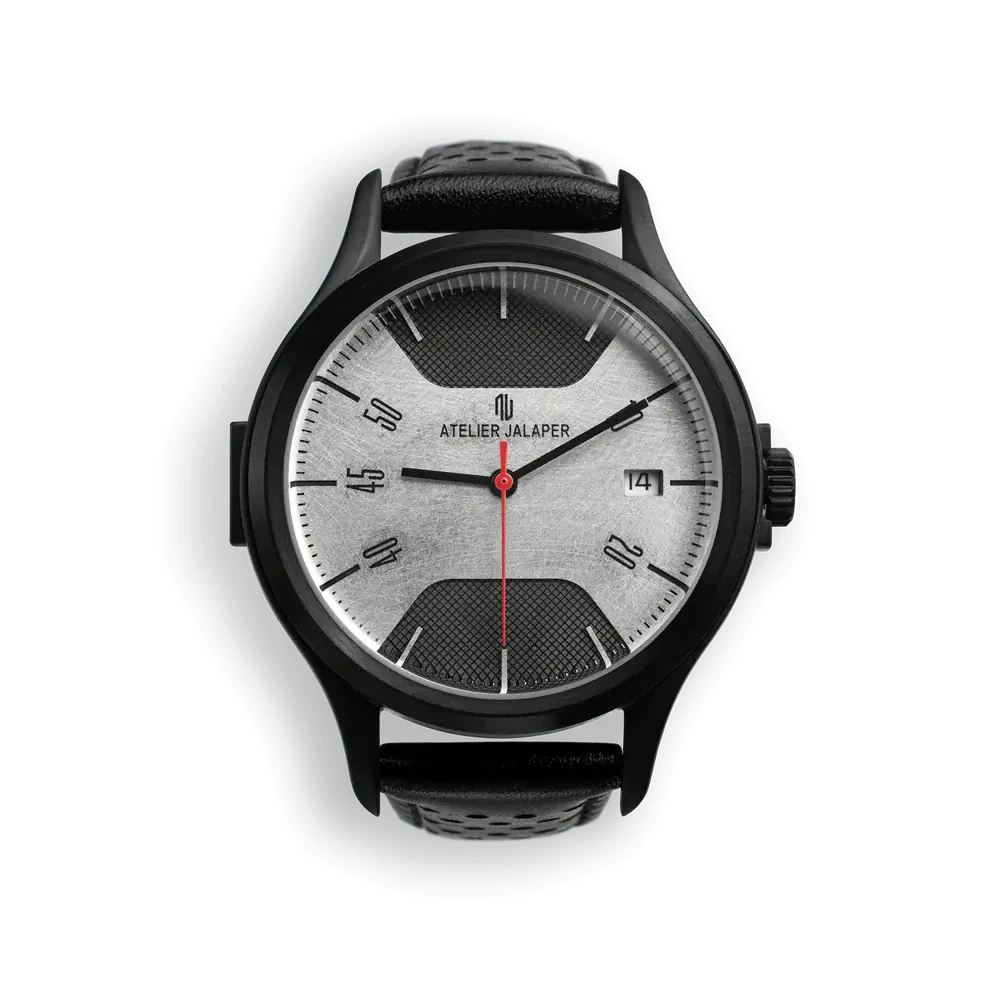
Atelier Jalaper has basically built its brand around taking pieces of famous cars and turning them into watches. There have been Lamborghini Miura dials, a Jaguar E-Type collection and, most importantly for this list, the Aston Martin DB5.
Because forget the Seamaster for a second. Anyone can buy a Bond watch. If I am going to do it, I want one that is literally made from Bond's car.
The dial on Atelier Jalaper's DB5 watches is cut directly from an authentic Aston Martin DB5 bonnet. The brand spent around a year working out how to turn that old bodywork into an actual usable watch dial, while deliberately keeping the scratches, chips and patina that tell you the metal had a life before it ended up behind sapphire.
That is what makes this more than a bit of automotive-themed decoration. The material itself is part of the point.
And if you are going to turn a car into a watch, surely the DB5 is about as good as it gets. It is one of the most recognisable cars ever made and, thanks to James Bond, probably about as close as the automotive world gets to having its own Submariner.
Hublot made a watch out of Novak Djokovic's clothes
Next up is Hublot.
Do not switch off. I will get through this quickly.
The Big Bang Tourbillon Novak Djokovic GOAT Edition was too strange not to include because the case material contains actual equipment used by Djokovic himself: 18 of his Lacoste shirts and 12 of his tennis racquets.
Which is a little weird, but also extremely Hublot.
There are blue, orange and green versions representing hard court, clay and grass, and the number produced in each colour corresponds to how many tournaments Djokovic had won on that surface when the collection was launched.
Then Hublot kept going.
The automatic tourbillon movement does not use a conventional-looking mainplate. Instead it has been machined into a lattice designed to resemble the strings of a tennis racquet. The bezel screws look like tennis balls, the strap picks up the texture of racquet grip tape, and the whole thing is basically a Djokovic reference from one end to the other.
So yes, it is a six-figure Hublot. But at least this time the material story is genuinely bonkers.
A piece of the Dunkirk evacuation
Back into the niche stuff now, with William Wood.
This is a brand that already has a habit of putting actual firefighting history into watches. Its straps can be made from decommissioned fire hose and some models use metal from old British firefighter helmets.
The Dunkirk Watch goes quite a bit further.
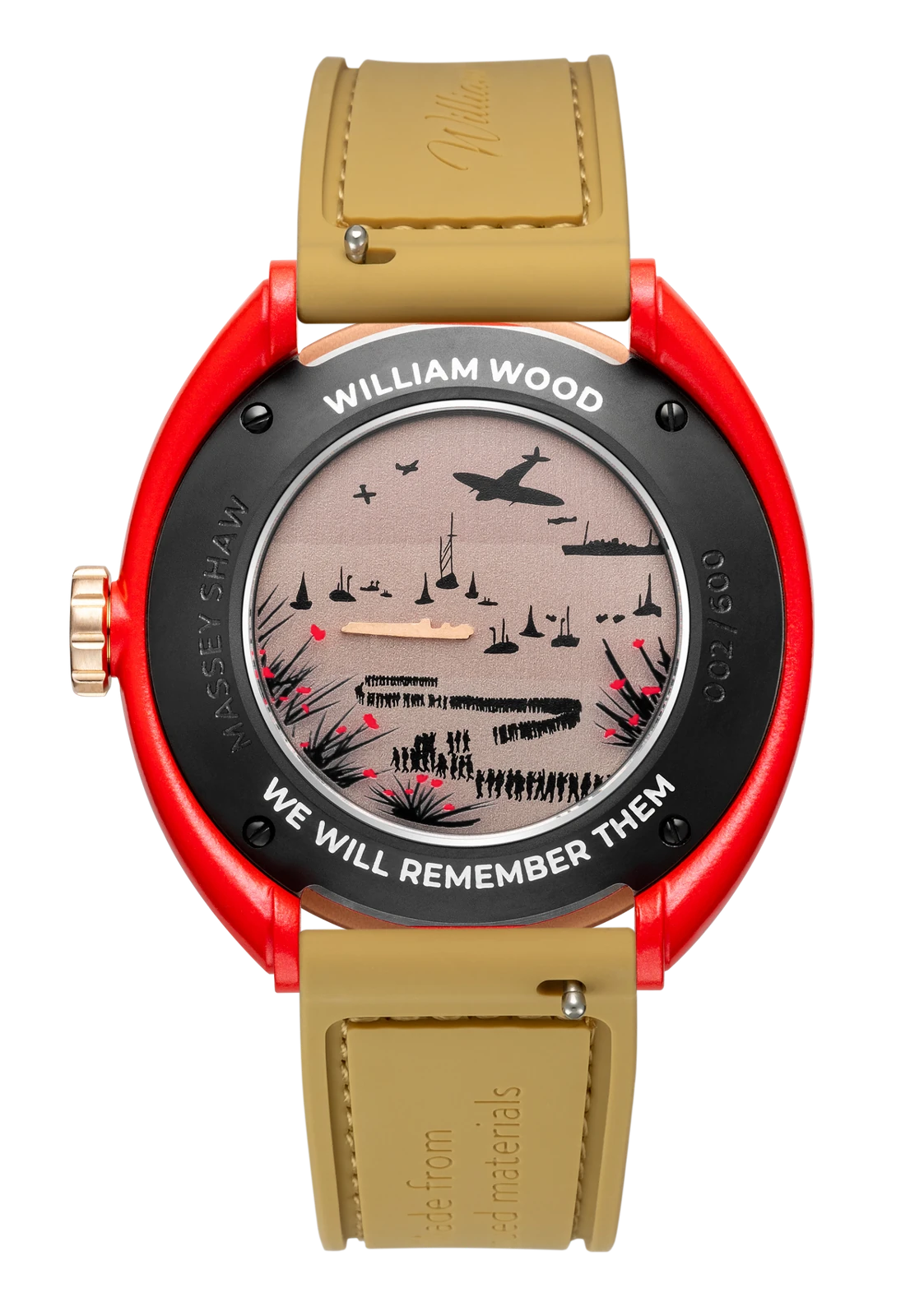
It was created with the Massey Shaw, a London Fire Brigade fireboat that crossed the Channel during Operation Dynamo and helped rescue more than 600 people from Dunkirk.
And tucked into the caseback is an actual piece of the boat's original engine.
William Wood melted down part of that engine and used the material to create the little silhouette of the Massey Shaw sitting inside the Dunkirk scene on the back of the watch.
The rest of the design carries the story through rather than just relying on the relic. The dial takes inspiration from the boat's twin engine telegraphs, the bronze case uses red detailing inspired by the engine room, and the strap continues William Wood's use of upcycled firefighting gear.
That makes this one particularly good for me. It is not simply commemorating Dunkirk; part of the machine that was actually there has been given another life inside the watch.
A few honourable mentions
Before we keep moving, there are a few watches that deserve a quick mention even though availability has moved around over time.
TRIWA made its Humanium watches using metal from confiscated firearms that had been melted down.
Praesidus has made watches using genuine Second World War parachute material, and it has also used material connected to famous battlefields, including black sand from Iwo Jima and sand from Utah Beach.
Bremont incorporated original fabric from the 1903 Wright Flyer into a limited-edition watch.
And Romain Jerome famously used actual steel connected to the Titanic.
Slightly morbid, that last one, but it shows how deep this rabbit hole gets.
The Flying Scotsman becomes a watch
We have had the automobile, so naturally we need a train.
Zero West is a British brand that could almost fill this entire article by itself. It has made watches using material from Vulcan bombers, Spitfire engines, Lancaster bombers and Merlin engine components.
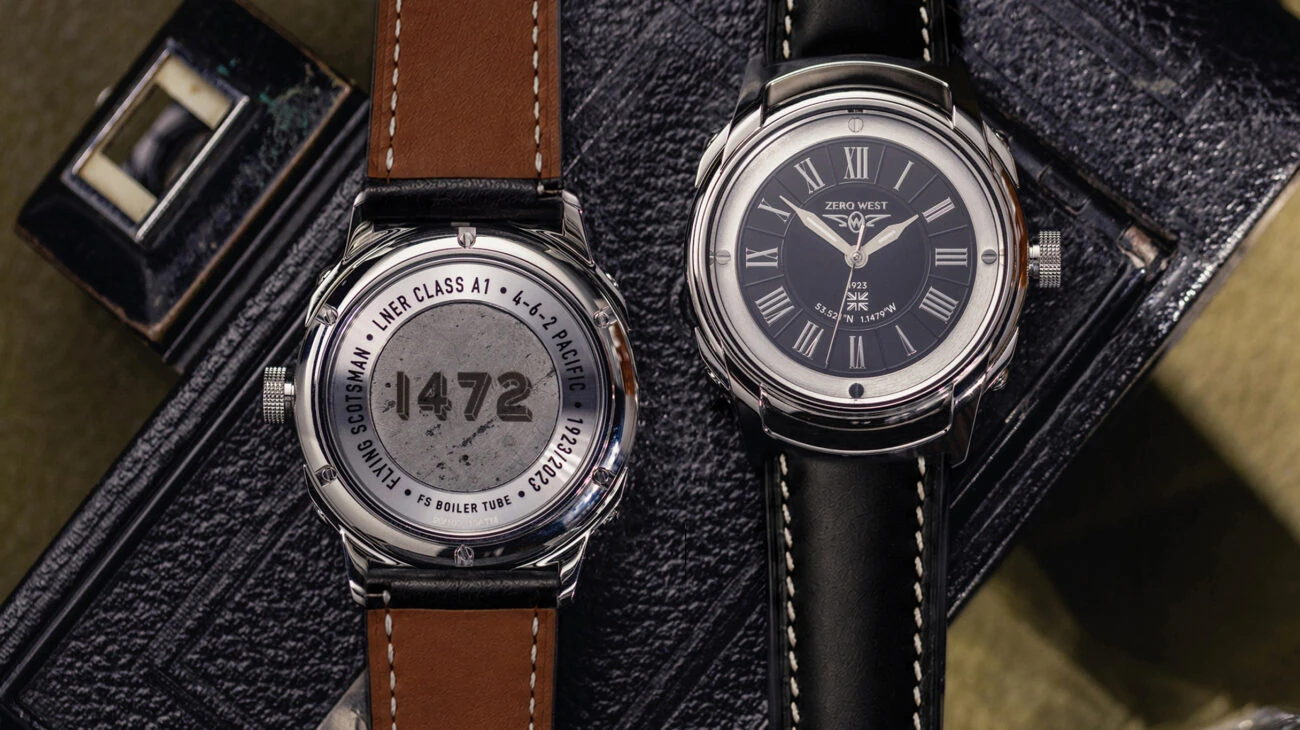
But the one I wanted here is the FS-2 Flying Scotsman.
The Flying Scotsman entered service in 1923, became the first steam locomotive to be officially authenticated at 100 miles per hour and became famous for running London to Edinburgh non-stop.
To mark its centenary, Zero West worked with the National Railway Museum and obtained a section of steel boiler tube that had been removed from the locomotive during a refit.
That tube had spent decades doing actual locomotive things, so it was not exactly ready to drop into a watch. Zero West had to clean off the accumulated grime, slit the tube, flatten it, machine it to the required thickness and punch individual steel discs from the resulting sheet.
One of those discs then sits under sapphire on the caseback, engraved with the Flying Scotsman's original 1472 number.
I like this one because you can still see the point of the material. It has not been melted into something anonymous. You are looking at a preserved piece of steel that used to be part of one of the most famous locomotives ever built.
When I was putting the original video together, the 100-piece edition had already become difficult to get. That is slightly annoying, because I needed a train for the thumbnail and this was far too good not to include.
Sinn's submarine steel actually used to be a submarine
Sinn has been making dive watches from submarine steel for roughly two decades, but there is an important distinction here.
Normally, that means new steel of the same type used to build submarines.
The U15, U16 and U18 are different.
These watches use actual hull steel taken from three decommissioned German Navy Type 206 submarines. So this time when Sinn says submarine steel, it really does mean steel from a submarine.
The U15 is the one I would pick out. Its donor submarine entered service in the 1970s and covered more than 200,000 nautical miles before retirement. Sinn then took material from the outer hull and turned it into the watch case and bezel.
This is not a tiny commemorative fleck hidden behind the movement. The physical body of the watch used to be part of a submarine.
It is also still very much a Sinn dive watch: 41mm, water resistant to 500 metres, powered by a Sellita SW300-1 and with the bezel given Sinn's Tegiment hardening treatment.
Apparently ex-submarine steel was not tough enough already.
A First World War aircraft engine reborn as a watch case
Then we get airborne.
Sopwith Watch Company is another brand that seems almost purpose-built for this subject. Its range includes watches made from cockpit armour and aircraft-engine components from some extraordinary old machines.
The standout for me is the Nieuport 28.
The entire case is made using steel from a Gnome Monosoupape 9 Type N rotary engine associated with an American Nieuport 28 fighter from the First World War.
And Sopwith does not just saw a small piece off and hide it under a window.
The old engine components are dismantled and analysed, the different steels are processed and melted in the company's foundry in Houston, the resulting material is brought up to a modern engineering standard and then cast into the actual watch case.
So once again, the thing around the movement used to be something completely different.
The Nieuport 28 is 41mm, water resistant to 200 metres and powered by an ETA 2893-2 GMT movement. Only 98 are being made.
And Sopwith absolutely nailed the line that goes with it: you couldn't be on the Western Front in 1918, but your watch was.
That is annoyingly good marketing.
The SR-71 Blackbird is now a watch dial
If Sopwith feels tailor-made for this list, REC Watches might be even more so.
Its entire idea is recovering material from historically significant machines and building watches around it. The catalogue has included parts from the first production Ford GT40, Ayrton Senna's Lotus 98T, Porsche 956 race cars, McLaren F1 GTRs and Spitfires.
But the one that tops them for me is the Habu.
It is made using titanium from SR-71 Blackbird 61-7956, the aircraft that logged more flights and more flight hours than any other Blackbird.
REC sourced Grade 6 titanium from the aircraft's inner engine nacelle exhaust ejector and used it in the lower section of the dial.
I will admit that “inner engine nacelle exhaust ejector” is beyond my aeronautical-engineering knowledge, but it sounds spectacular and, more importantly, the material can be traced back to the actual aircraft.
The Habu itself is 40mm, uses a manually wound Sellita SW270-1 and is limited to 1,372 pieces.
And this might be the point where the prices in this article start to feel weirdly relative. A watch containing titanium from a real SR-71 Blackbird is expensive, obviously, but compared with plenty of luxury watches that contain nothing more historically exciting than stainless steel, it almost starts to sound reasonable.
Almost.

An object that actually flew on Space Shuttle Atlantis
Why stop at aircraft when we can keep going up?
Bristol Watch Company has produced tribute watches connected to all sorts of aircraft, including Spitfires, Mustangs, B-17s, B-25s, F-18s and even the Boeing 747.
But obviously I am picking the Space Shuttle.
The Space Shuttle Atlantis Tribute contains an authentic space-flown artefact that travelled aboard Atlantis during STS-79 in 1996.
That distinction matters. This is not necessarily a piece cut from the shuttle's structure itself; it is an object that genuinely flew aboard Atlantis during the mission.
STS-79 was Atlantis's fourth docking with the Russian Mir space station and included the first exchange of American astronauts aboard Mir. During the mission the shuttle orbited Earth 160 times and travelled roughly 3.9 million miles.
Eventually, material from that mission ended up displayed in the back of a watch.
The watch is 44mm, uses a Swiss quartz chronograph movement and is limited to 1,996 pieces to match the year of the flight.
And that is the bit I love about this whole category. For less than the price of plenty of fairly ordinary watches, it is possible to have an object on your wrist that has genuinely been to space.
But then again... only orbit.
The watch with Apollo 11 inside it
Which brings us to the obvious place to finish.
This is going to sound like a video where I deliberately pick on Omega.
The Speedmaster earned the Moonwatch name honestly. There is no argument there. But the one you buy today has probably done little more than leave Switzerland.
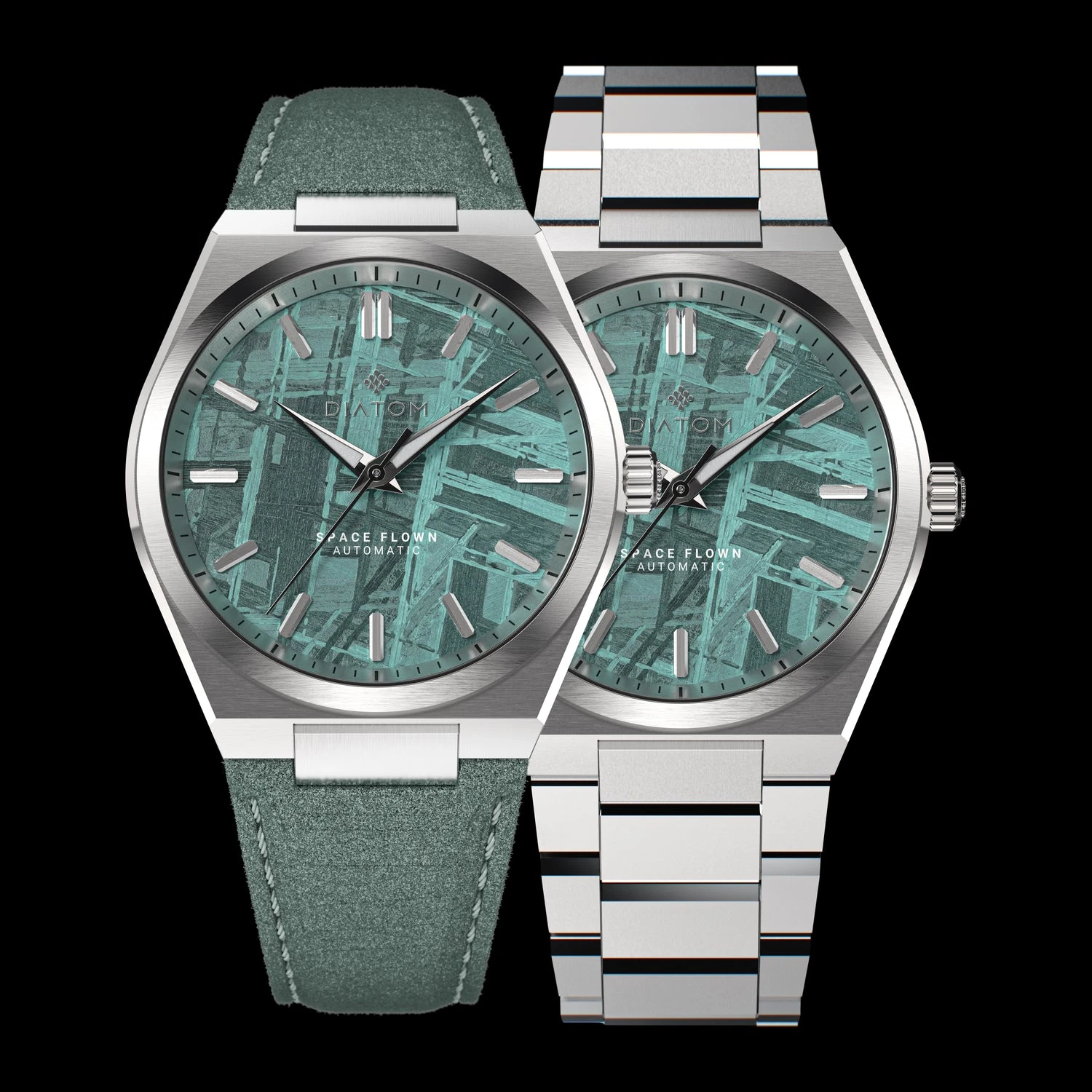
The Diatom Terra Meteorite contains material recovered from Columbia, the Apollo 11 Command Module.
Specifically, Diatom uses authentic material derived from the Kapton thermal-protection foil that was attached to Columbia during the mission. That material travelled to lunar orbit and back, survived re-entry and was later recovered from the spacecraft.
Diatom combines it with titanium to create a proprietary alloy used for the watch's chapter ring.
Exactly how much Apollo 11 material ends up in that final alloy is harder to pin down, and I think it is worth being open about that rather than pretending otherwise. But even with that qualification, the fact that genuine mission-flown Columbia material is part of the watch is a pretty spectacular connection to have on your wrist.
And somehow that is not even the only space story going on.
The dial itself is cut from Gibeon meteorite, material that is around 4.5 billion years old. Then, because apparently Apollo 11 material and meteorite were not enough, Diatom also sends the completed watches high above Earth and gives owners footage of their own watch's journey.
Internally, things are more conventional: a Sellita SW200 automatic movement inside a modern sports-watch case. But that is almost beside the point.
For a space geek, this is pretty close to the perfect ending.
The Speedmaster might be the Moonwatch.
But this thing contains material that got a lot closer to the Moon than anything you are likely to pick up from an Omega boutique today.
And I think that is about as ridiculous a place as we can possibly end this list.
If you know of another watch made from something with an even better story, let me know. I am very clearly not finished going down this rabbit hole.