
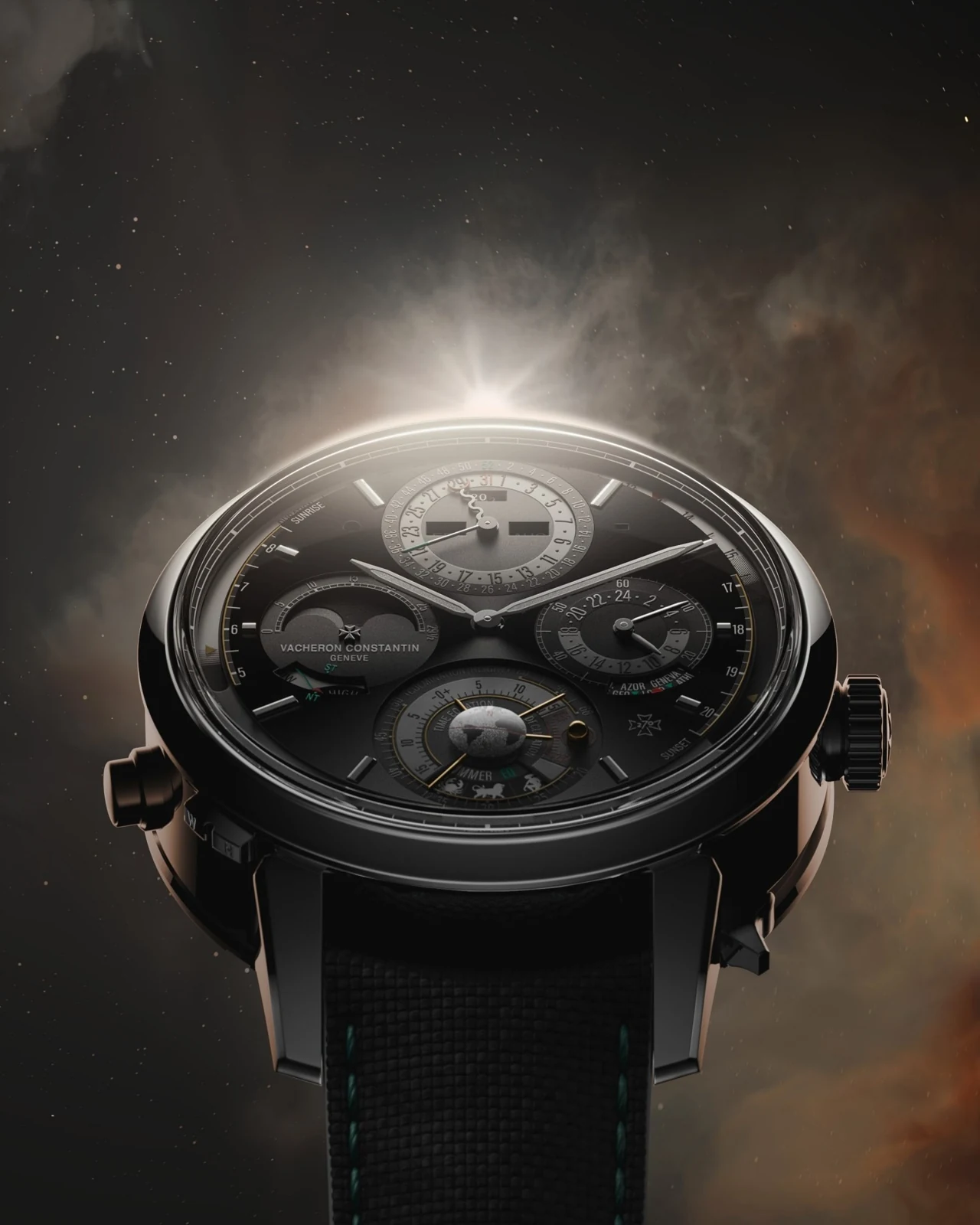
This is the Vacheron Constantin Les Cabinotiers Solaria Ultra Grand Complication – La Première.
Which is a ridiculous name for a frankly ridiculous watch.
When Vacheron unveiled it in 2025, it became the most complicated wristwatch ever made.
Inside are 1,521 individual components performing 41 complications.
For context, a modern Omega Speedmaster contains somewhere around 250 components.
So there are roughly six Speedmasters' worth of mechanical bits crammed inside this one watch.
That sounds impressive.
It is also almost completely meaningless if you have no idea what those 41 complications actually do.
Some are familiar. There is a perpetual calendar, a tourbillon and a split-seconds chronograph.
Some are considerably less familiar.
The Solaria can tell you about spring and neap tides.
It can calculate solar noon.
It keeps sidereal time based on the movement of the stars rather than the Sun.
And, most absurdly, it contains an entirely mechanical system designed to calculate how long you need to wait before a chosen star or constellation reaches a particular point in your field of view.
So rather than simply admire a very expensive black dial covered in numbers, let's work through Vacheron Constantin's own list and figure out what all 41 complications actually do.
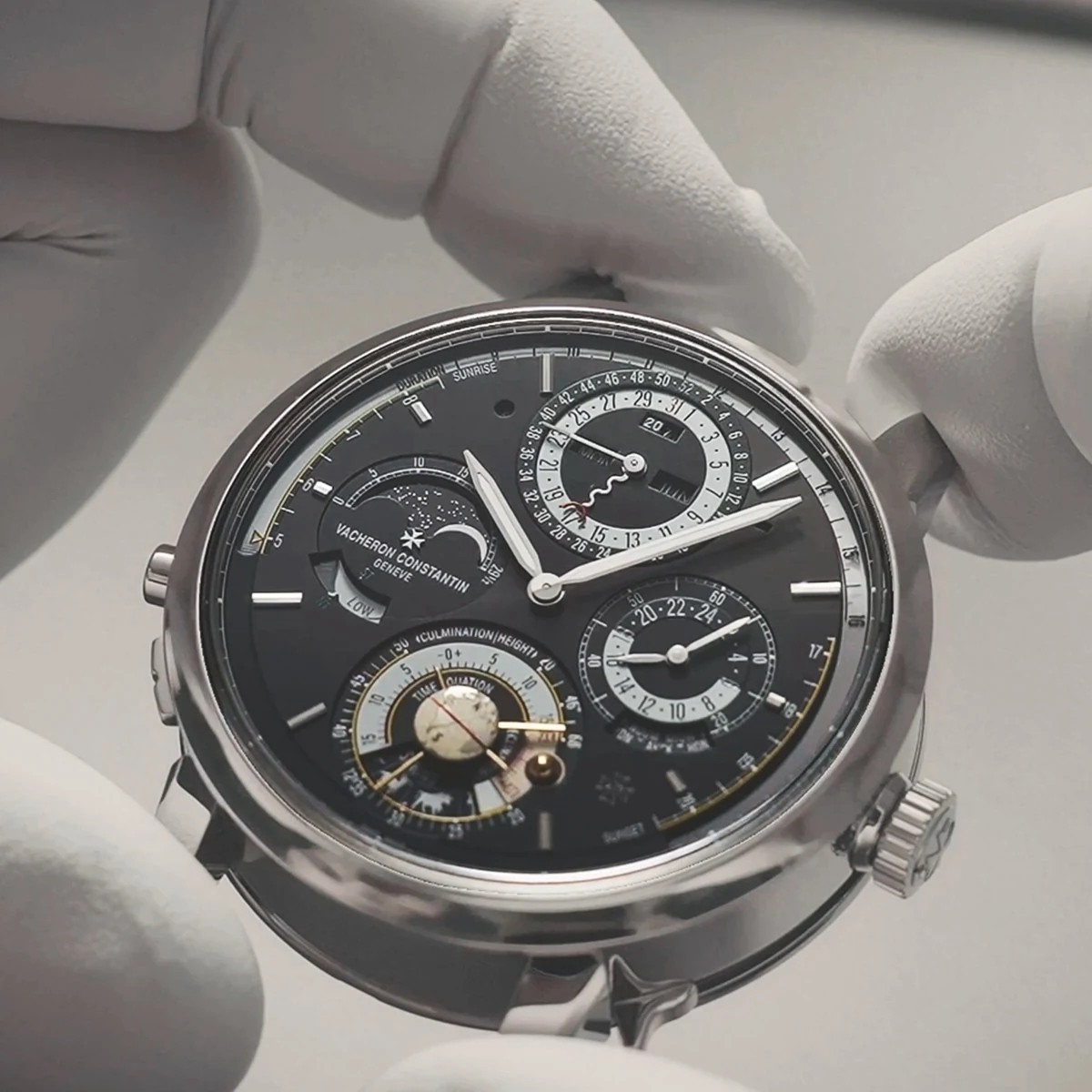
Time measurement
Vacheron begins with six complications relating to basic time measurement.
And even in this supposedly straightforward category, we already have a tourbillon.
1. Day and night indication for the reference city
Around the perimeter of the dial is a day and night indication linked to the watch's reference city.
The Solaria's astronomical functions are calculated for a specific geographical location, Geneva on the original watch.
That location matters enormously once we get into sunrise, sunset and the position of the Sun later.
For now, this indication simply tells you whether the reference location is experiencing day or night.
2. Second time zone
At three o'clock is a 24-hour display for a second time zone.
This gives you the hours and minutes somewhere else in the world without disturbing the main local-time display.
Pretty conventional by Solaria standards.
3. World time for 24 cities
Just below it is a world-time display using 24 cities to represent 24 time zones.
Again, something we have seen in plenty of other watches.
Enjoy this relative normality while it lasts.
4. Day and night for the second time zone
Vacheron then counts the day and night indication associated with that second time zone as another complication.
It might not be the most spectacular entry on the list, but it gives you an immediate visual indication of whether the second location is currently in daytime or nighttime.
And yes, we are going to encounter a few entries where Vacheron's method of reaching 41 feels fairly generous.
5. 3Hz tourbillon with silicon balance wheel
Then we have to go inside the watch.
The Solaria uses a 3Hz tourbillon regulator with a silicon balance wheel.
A tourbillon rotates the escapement and balance assembly within a cage, historically as a way of averaging positional errors caused by gravity.
The funniest thing about the Solaria's tourbillon is almost how little attention it receives.
Many watches would build their entire visual identity around having one.
Vacheron hides this one underneath the dial because apparently it has more interesting things to show you.
6. Civil time display module coupled to the base movement
And finally we have what Vacheron describes as the civil time display module coupled to the base movement.
In simpler terms:
The watch tells the time.
Hours and minutes.
The fundamental purpose of a wristwatch has officially made the list.
That takes us to six.
So far, despite casually hiding a tourbillon under the dial, we have not encountered anything too difficult.
That is about to change.
Gregorian perpetual calendar
The large display at 12 o'clock contains the Solaria's Gregorian perpetual calendar.
Vacheron counts eight complications here.
7. Perpetual calendar
The perpetual calendar is the mechanism doing the clever work behind the scenes.
A normal date watch assumes every month has 31 days, which is why you have to correct it five times a year.
A perpetual calendar mechanically accounts for 30-day months, February and the leap-year cycle.
Set correctly and keep it running, and the calendar can handle those changes without manual correction.
8. Day of the week
Monday.
Tuesday.
Wednesday.
You get the idea.
9. Pointer date
The Solaria also displays the numerical date using a pointer indication.
10. Month
January through December is tracked mechanically as part of the perpetual-calendar system.
11. Four-digit year
This is where things become slightly more ambitious.
Rather than merely displaying a leap-year cycle, the Solaria includes the full four-digit year.
12. Leap-year indication
There is also a dedicated indication showing where the watch currently sits within the four-year leap-year cycle.
13. ISO week number
And now we reach one of my favourite complications purely because of how aggressively administrative it is.
The Solaria can tell you the numbered week of the year, using the ISO 8601 calendar system.
Have you ever desperately looked at your wrist and wondered whether you are currently in week 37?
Vacheron has you covered.
14. Numerical day of the week
It also gives the day of the week as a number.
Under ISO 8601, Monday is day one and Sunday is day seven.
Which finally gives us mechanical confirmation that Sunday is the seventh day of the week and not the first, regardless of what some calendars insist on telling you.
One subdial has now taken us from six complications to fourteen.
The Moon and the tides
At nine o'clock are three lunar indications.
15. Astronomical Moon phase and age of the Moon
The first is an astronomical Moon phase and Moon-age display.
Vacheron says the Moon-phase indication will remain accurate for around 122 years before requiring a one-day correction.
Which should be enough for most owners.
16. Tide level
Directly associated with the Moon is a tide-level indicator.
This shows where you currently are within the tidal cycle, effectively indicating the movement towards high or low tide.
17. Spring and neap tides
Then we get something I genuinely had to look up while making the original video.
Spring and neap tides.
Spring tides occur when the Sun, Earth and Moon are broadly aligned, producing a greater difference between high and low tide.
Neap tides occur when the Sun and Moon sit roughly at right angles relative to Earth, reducing that tidal range.
So yes.
Your Vacheron Constantin can tell you what sort of tide is happening.
We are at 17 complications.
And now we get to the properly strange stuff.
Fourteen astronomical complications
The Solaria includes 14 astronomical indications.
This is the section that turns the watch from an extraordinarily complicated calendar into something approaching a mechanical observatory.
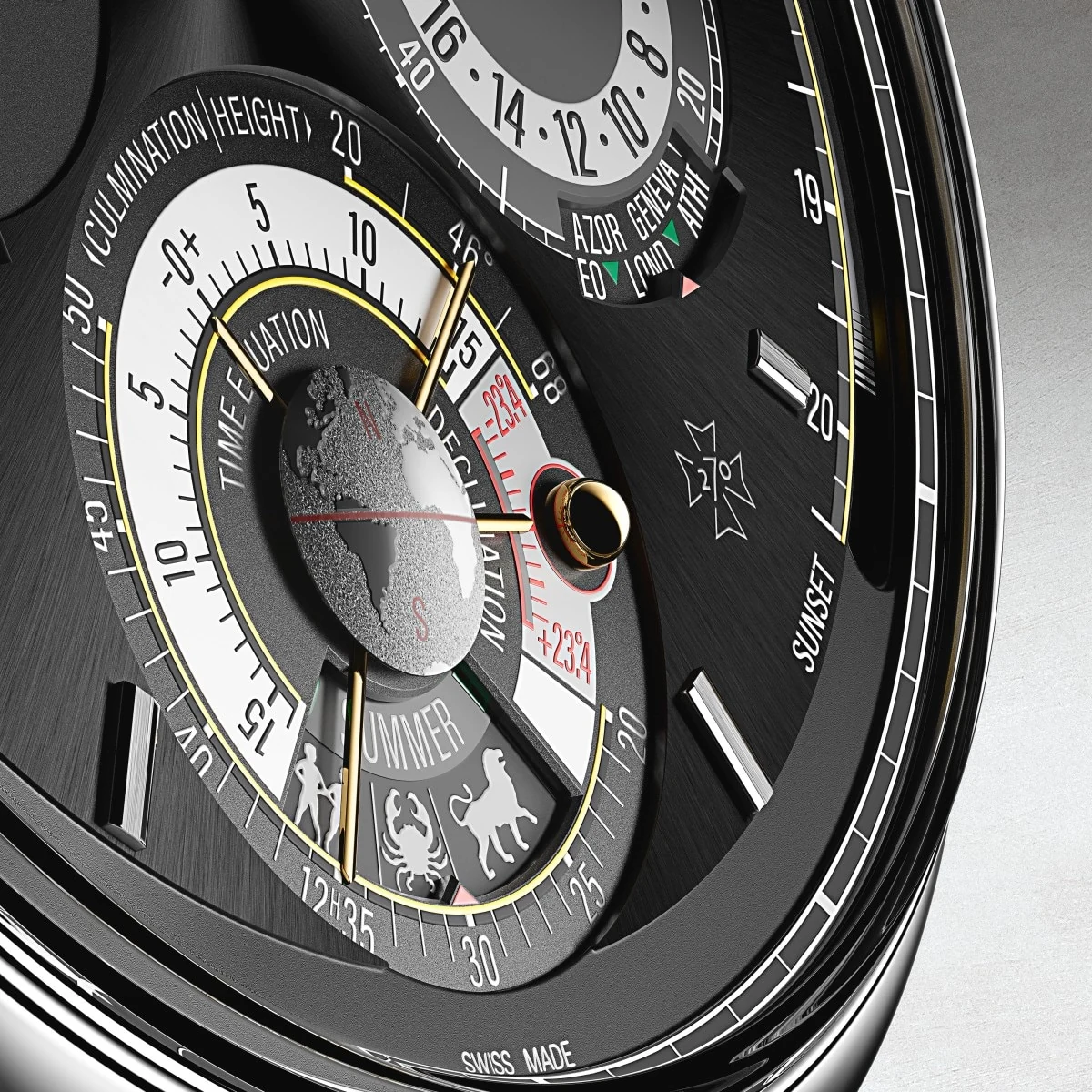
18. Seasons, equinoxes and solstices
The display at six o'clock tracks the progression of the seasons along with the equinoxes and solstices.
We have officially moved beyond asking what day it is and started mechanically tracking where Earth sits in its annual journey around the Sun.
19. Position of the Sun
A small yellow representation of the Sun moves around the outer section of the dial.
When the watch is oriented correctly relative to the cardinal points, it provides an indication of the Sun's position across the sky for the reference location.
20. Sunrise time
The Solaria calculates the local sunrise time for its reference city.
On the original watch, that reference is Geneva.
Because these calculations depend on latitude and geographical location, a future Solaria can be configured around the owner's chosen reference city.
Which is the least Vacheron can do if you are somehow wealthy enough to commission one of these things.
21. Sunset time
Naturally, if it knows when the Sun rises, it also knows when it sets.
Again, the calculation is specific to the reference location.
22. Duration of the day
From the sunrise and sunset calculations, the Solaria also displays the length of the day.
So this thin area around the dial can tell you where the Sun is, when it appears, when it disappears and how long it remains above the horizon.
23. Equation of time
The equation of time sounds much more intimidating than it really is.
The 24-hour day used by our clocks is an average.
Apparent solar time, the time you would obtain from the real position of the Sun, varies throughout the year because of Earth's orbit and axial tilt.
Depending on the time of year, a sundial can differ from civil time by roughly a quarter of an hour.
The equation-of-time indication tells you the size of that difference.
In other words, the Solaria tells you how wrong your sundial currently is.
24. Culmination time of the Sun
The Solaria also calculates solar culmination.
That is the moment when the Sun reaches its highest point in the sky for the reference location.
Effectively, solar noon.
Because solar time and civil time are not identical, that does not necessarily occur at exactly 12:00 on your watch.
25. Height of the Sun
Next is the Sun's height above the horizon.
This is displayed as an angular measurement.
I cannot think of a single occasion on which I have desperately needed this information from my wrist.
But now I know it can be done mechanically, I am glad somebody bothered.
26. Declination of the Sun
The Solaria also displays solar declination.
This tells you how far north or south of Earth's celestial equator the Sun appears.
At this stage, I think we have extracted just about every conceivable piece of information about the Sun's whereabouts.
So it is time to flip the watch over and start dealing with the stars.
27. Sidereal hours
On the caseback, the Solaria displays sidereal time.
Civil time is based around the Sun.
Sidereal time is measured relative to the stars.
Earth takes roughly 23 hours, 56 minutes and 4 seconds to complete one rotation relative to distant stars, slightly less than the solar day used by our clocks.
The Solaria tracks that alternative astronomical timescale mechanically.
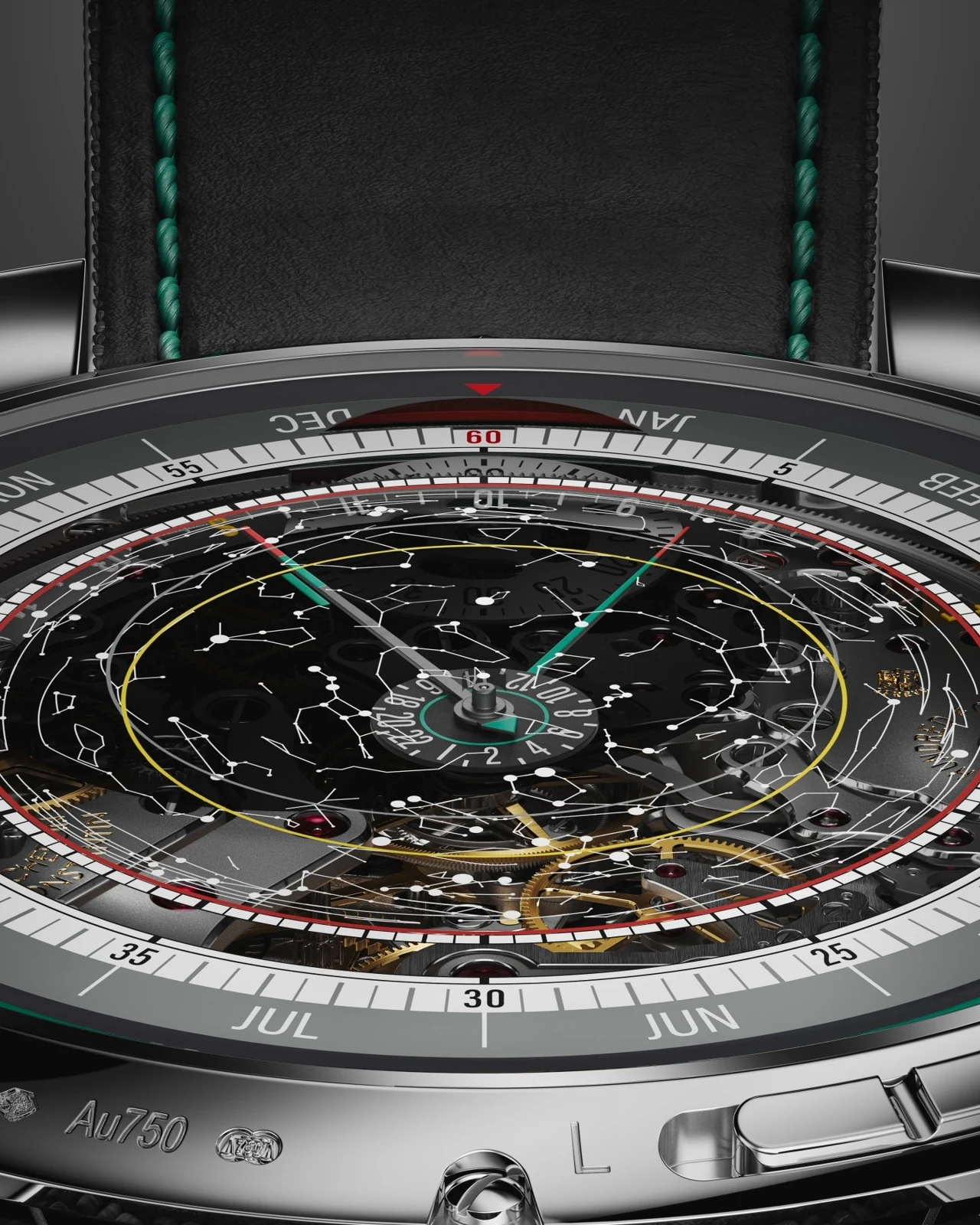
28. Sidereal minutes
And yes, Vacheron counts the sidereal minutes separately.
At this point we have probably established that the company is not shy when it comes to adding numbers to the complication tally.
29. Astronomical zodiac signs
Back on the front, the six o'clock astronomical display also tracks the astronomical zodiac.
Straightforward compared with what comes next.
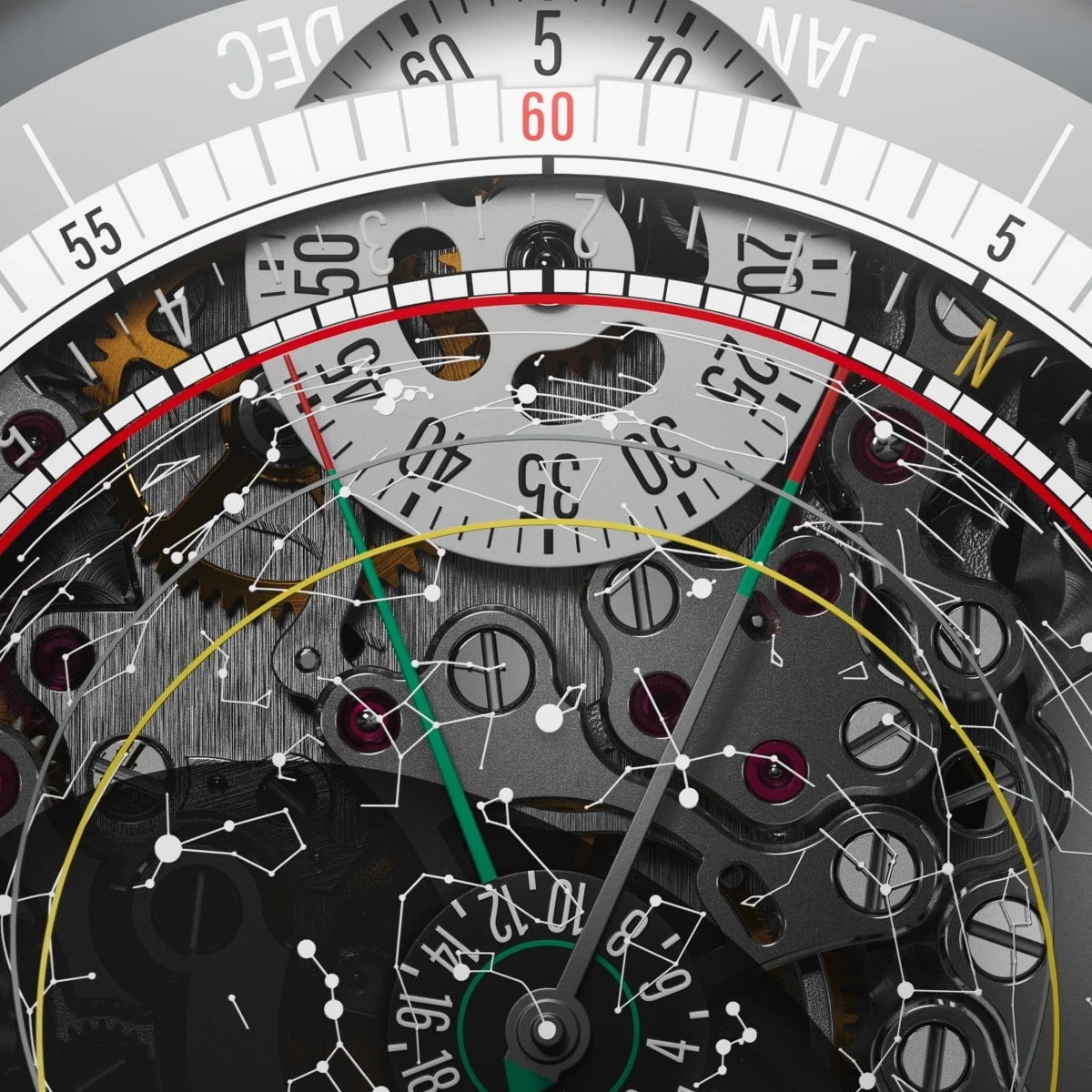
30. Rotating sky chart
The back of the watch contains an actual celestial chart.
And this is not just decoration.
The star map rotates to reproduce the apparent movement of the constellations across the sky for the reference location.
That would already be a ridiculous place to stop.
But Vacheron had one more astronomical trick left.
31. Temporal tracking of celestial objects
This is the world first.
And it is the complication that properly broke my brain when I first tried to understand the Solaria.
The watch combines its celestial chart with the split-seconds chronograph to calculate how long you need to wait before a chosen star or constellation reaches a specific point in your field of view.
You select the celestial object you want to observe on the star map.
The chronograph and rattrapante hands are then used against the celestial display and a fixed reference marker.
A central indication translates the angular difference into the number of hours you need to wait.
So, stripped of all the horological language:
You can choose a star on the back of your watch, and this entirely mechanical machine can tell you how long you need to wait until that star appears where you want it.
Which is completely ridiculous.
And very cool.
We have now gone from 17 complications to 31.
Five chiming complications
After all that astronomical madness, we move into sound.
Because apparently tracking stars was not enough.
32. Minute repeater
The Solaria contains a minute repeater.
Activate it and the watch mechanically chimes the current time.
Traditionally, different combinations of tones indicate the hours, quarter-hours and remaining minutes.
A normal minute repeater is already considered one of the most difficult complications in watchmaking.
Naturally, Vacheron did not stop there.
33. Westminster carillon
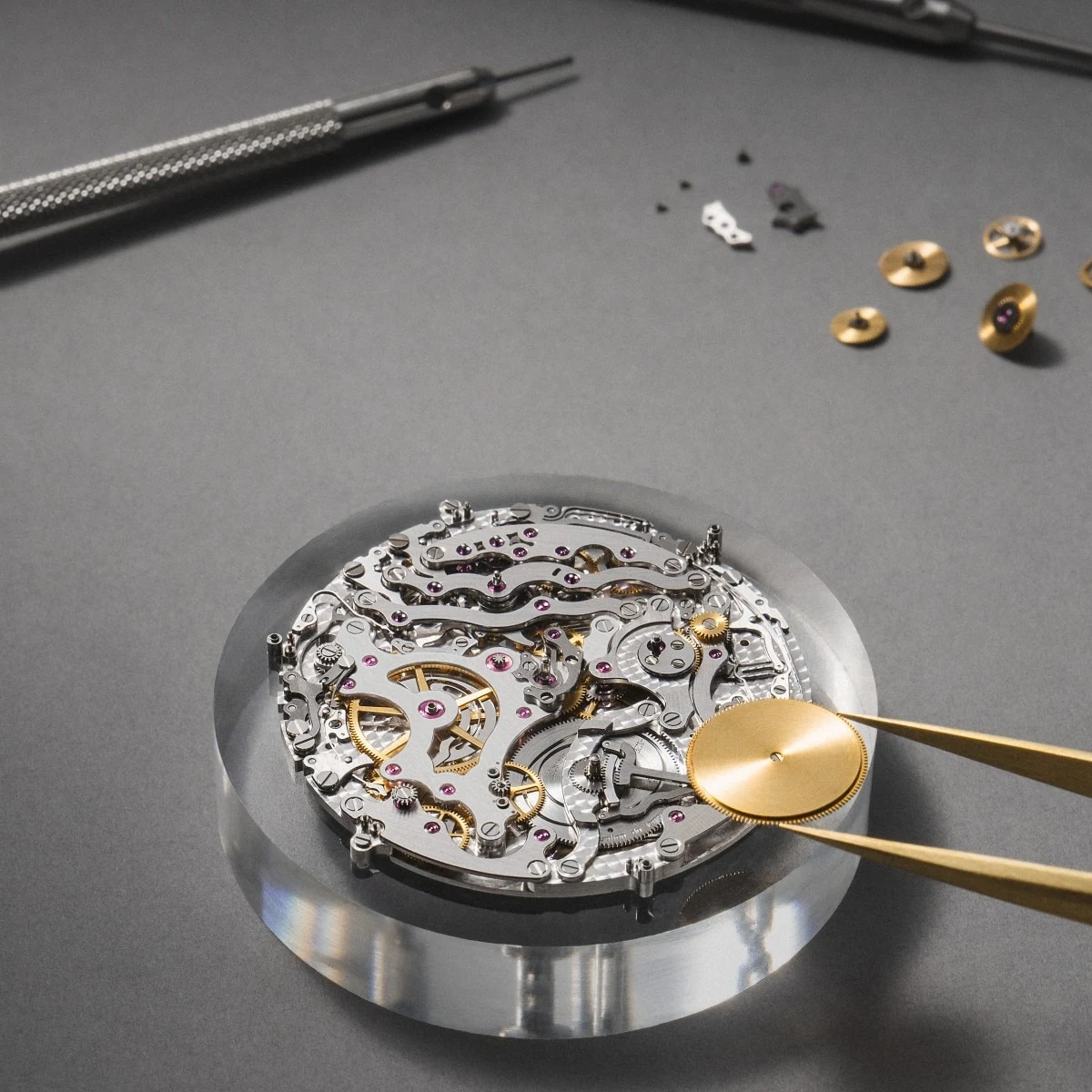
The Solaria uses a Westminster carillon with four hammers and four gongs.
Rather than the simpler two-tone arrangement used by many minute repeaters, four separate hammers strike four gongs to recreate a Westminster-style sequence.
Seven of the Solaria's 13 patent applications relate to its chiming system alone.
That gives you some idea of how seriously Vacheron approached this part of the movement.
34. Choice of full chime or hours only
The wearer can choose between the complete chiming sequence and an hours-only mode.
So if listening to the watch work through hours, quarters and minutes feels a little excessive, you can ask it to just give you the headlines.
35. Crown locking during chiming
The crown is automatically locked while the striking mechanism is operating.
This prevents adjustments from interfering with the watch while an extremely complicated sequence of mechanical events is already taking place.
Probably sensible.
36. Double-stop hammer system
When a repeater hammer strikes its gong, you do not want it bouncing back and making unintended contact or wasting energy.
The Solaria therefore uses a double-stop hammer system designed to control rebound and maximise the transfer of kinetic energy into the gong.
One clean strike.
Maximum energy.
Better sound.
Those five chiming functions take us to 36.
Split-seconds chronograph
After trying to explain sidereal time and mechanical star tracking, a chronograph suddenly feels refreshingly normal.
37. Chronograph
Yes.
It has a chronograph.
Start it.
Stop it.
Reset it.
The chronograph seconds are read around the outer edge of the reverse display.
38. 60-minute counter
A dedicated counter records elapsed chronograph minutes up to 60.
And yes, the minute counter counts as another complication.
I stopped arguing with the list somewhere around the ISO week number.
39. Split-seconds chronograph
This is where things get much more interesting.
The Solaria has a split-seconds chronograph, also called a rattrapante.
Two chronograph seconds hands sit directly on top of each other.
Start the chronograph and they move together.
Press the split-seconds control and one hand stops while the other continues.
That allows you to time two events that begin together but finish separately, or record an intermediate time without stopping the main chronograph.
These are also the hands doing a second job in the celestial-tracking system from complication 31.
Even the chronograph has a side hustle.
40. Split-seconds isolator system
When one rattrapante hand is stopped, you do not want the stationary split mechanism placing unnecessary drag on the still-running chronograph.
The Solaria therefore uses an isolator system to reduce that mechanical interference.
In simple terms, it lets you stop one chronograph hand without unnecessarily disturbing the one that is still moving.
That brings us to 40.
After perpetual calendars, four-gong Westminster chiming, solar declination and mechanically tracking stars, there is somehow still one complication left.
And finally...
41. Power reserve
A large red and green indication on the back tells you how much of the Solaria's roughly 72-hour power reserve remains.
Which feels almost aggressively ordinary after everything we have just been through.
Vacheron gives the power reserve its own category and saves it until the end.
So there we go.
41 complications.
What does 41 complications actually mean?
There is a legitimate argument to be had about how watch manufacturers count complications.
Vacheron counts things such as sidereal hours and sidereal minutes independently.
A 60-minute chronograph counter is its own complication.
So is a day and night display attached to a second time zone.
Meanwhile, some purists will argue that a tourbillon is technically a regulating device rather than a complication at all.
But debating whether the Solaria should contain 39, 40, 41 or 42 complications rather misses the point.
The absurdity is not just the total.
It is what the watch manages to combine.
A perpetual calendar.
World time.
Tides.
A tourbillon.
Solar indications.
Sidereal time.
A rotating celestial map.
A Westminster minute repeater.
A split-seconds chronograph.
And a completely mechanical system capable of calculating when a particular star will arrive in your chosen field of view.
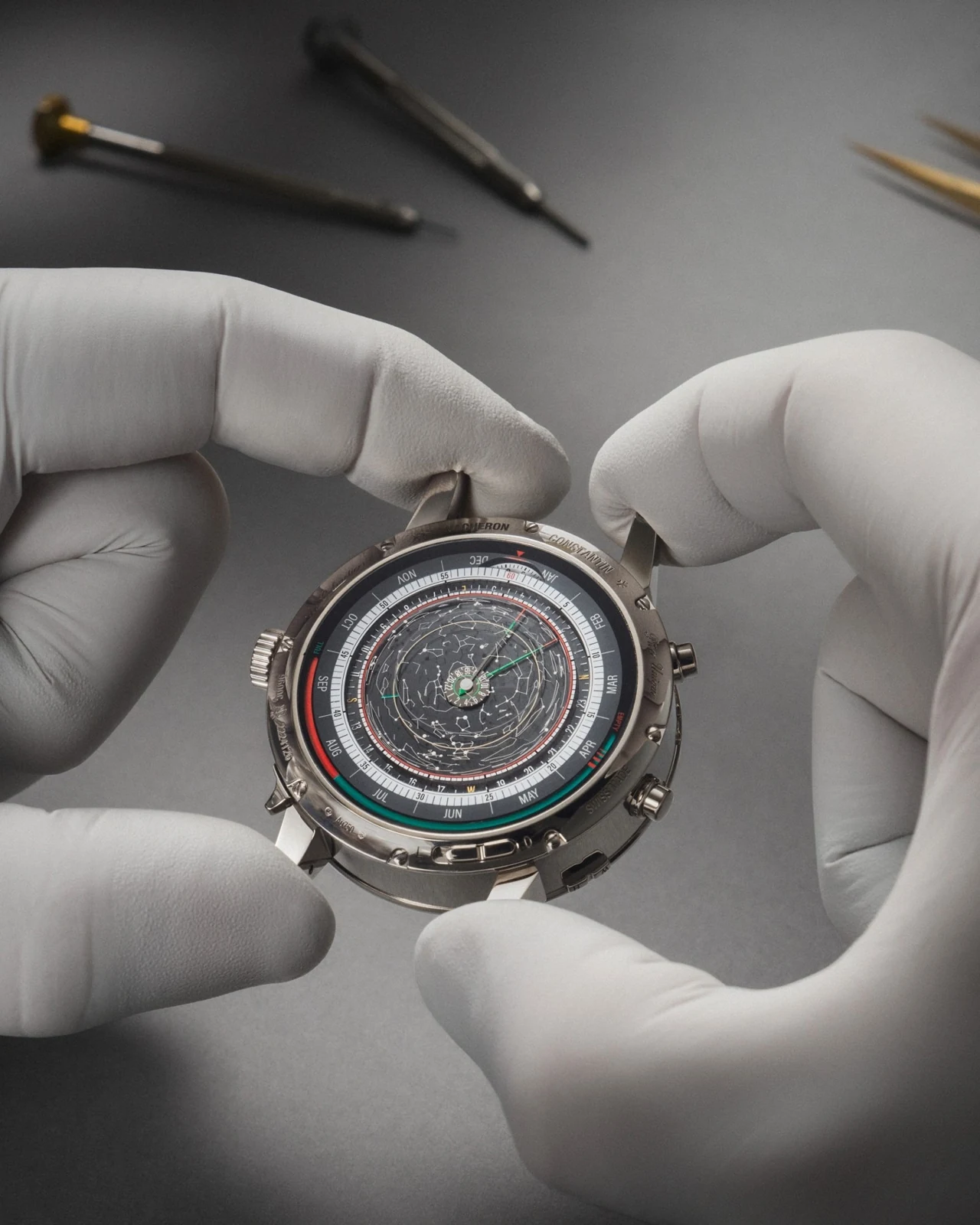
All of it is packed into Calibre 3655, made from 1,521 components.
More remarkable still, Vacheron managed to fit that movement into a wristwatch rather than something resembling a small desk clock.
The Solaria is certainly not the most practical watch ever made.
Several of its complications answer questions I had never previously thought to ask.
But that is also the appeal.
At the extreme end of mechanical watchmaking, practicality stopped being the objective a very long time ago.
This is watchmaking as an engineering exercise.
A demonstration of just how much information can be calculated, stored and displayed using nothing more than gears, springs, cams, levers and an unreasonable amount of human patience.
And if I had to pick a favourite complication?
There is something wonderfully absurd about spending this much engineering effort just so your watch can tell you what numbered week of the year it is.
Although mechanically tracking stars comes a fairly close second.