
Harry Winston might be one of the least discussed watch brands in the entire Swatch Group.
While the rest of the family is busy making Speedmasters, Fifty Fathoms, PRXs and perfectly sensible Longines, Harry Winston has spent portions of its history exploring much more important questions.
What if a tourbillon wasn't complicated enough?
What if we used four of them?
What if we gave some of the most interesting independent watchmakers in the world a pile of resources and told them to make whatever they wanted?
And somehow, very few people seem to talk about any of it.
There is an obvious reason for that.
Harry Winston is, first and foremost, a jewellery house. Diamonds, precious stones and red carpets occupy a much bigger part of the brand's public identity than obscure mechanical complications.
But start digging through the watchmaking archive and things get weird very quickly.
Harry Winston has produced watches with satellite time displays, mechanical diamond conveyor belts, multi-axis tourbillons and even what can only reasonably be described as a tiny mechanical jukebox for your wrist.
And all of this comes from a company now sitting inside the Swatch Group.
So how did that happen?
Before things got weird
Harry Winston's watchmaking story actually began relatively sensibly.
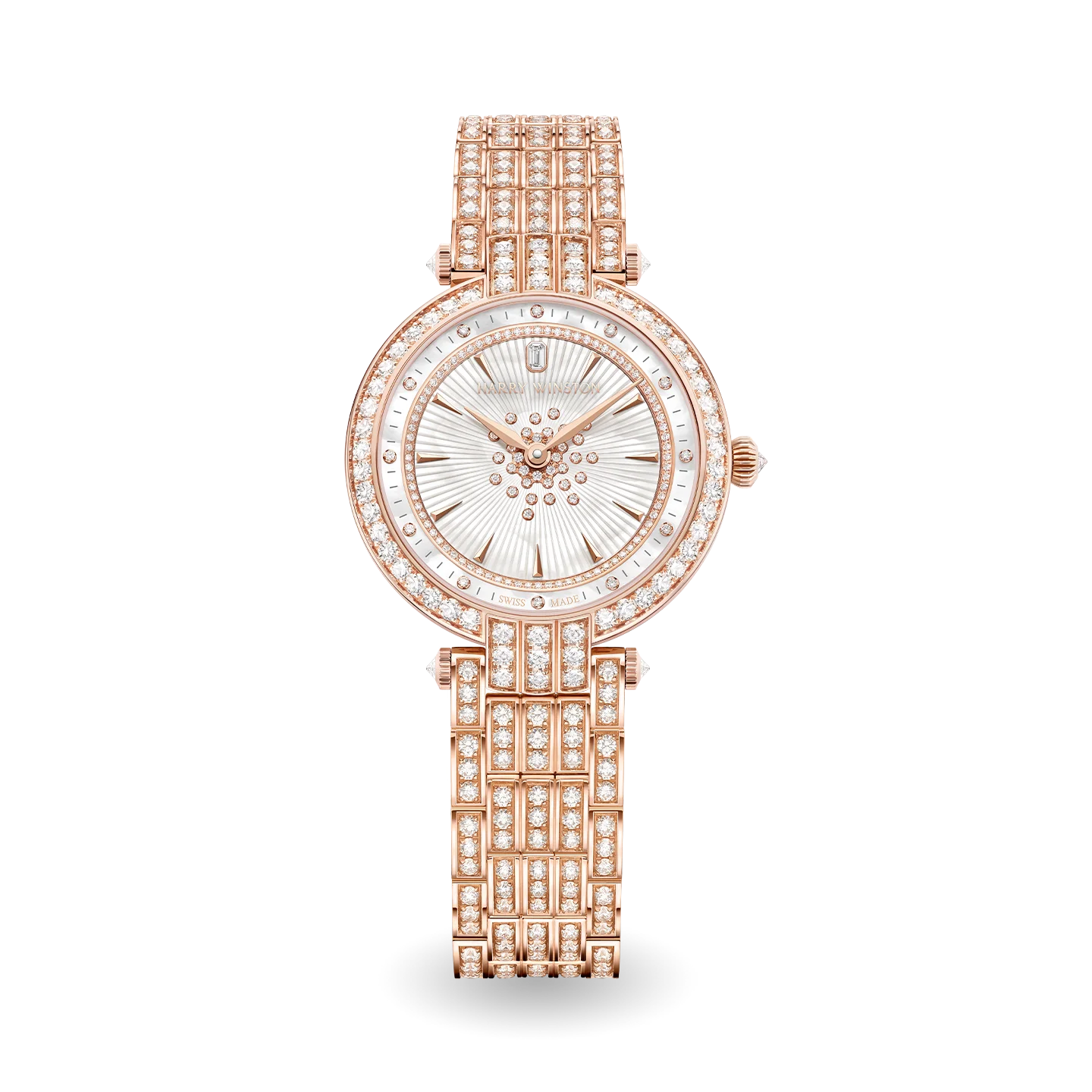
The Premier collection arrived in 1989, the first watch collection launched by the House.
Even then, the watches were designed to look distinctly Harry Winston. The three arches around the lugs were inspired by the entrance to the company's Fifth Avenue flagship salon in New York, bringing a recognisable piece of the jewellery house into the watch itself.
Then came the Ocean collection in 1998.
This was the sportier side of Harry Winston, although "sports watch" means something slightly different when the company making it is Harry Winston. White gold and significant quantities of diamonds were never particularly far away.
More importantly, the watches started becoming mechanically interesting.
Retrograde displays became a recurring theme. There were unusual dial layouts, perpetual calendars, dual times, chronographs and tourbillons.
Harry Winston did not necessarily develop every complicated mechanism entirely in-house.
It worked with specialist Swiss watchmakers and movement designers, including Jean-Marc Wiederrecht, founder of Agenhor.
And this is where Harry Winston's lack of conventional watchmaking heritage became strangely useful.
There was no century-old sports watch that enthusiasts would riot over if somebody changed the hands.
No sacred design language.
No obligation to keep producing slight variations of something created in 1957.
Harry Winston could essentially do whatever it wanted.
Then Max Büsser arrived to run its rare timepiece division.
If that name sounds familiar, the initials MB would later become the first half of MB&F.
And Büsser had an idea.
Instead of asking independent watchmakers to help Harry Winston design Harry Winston watches, why not give those watchmakers the resources to create something much closer to whatever they wanted?
That idea became Opus.
Opus: give brilliant watchmakers money and see what happens
The Opus project began in 2001.
Over the following years, the list of collaborators became almost comical.
François-Paul Journe.
Vianney Halter.
Felix Baumgartner.
Martin Frei.
Andreas Strehler.
Robert Greubel.
Stephen Forsey.
These are not obscure suppliers whose names watch collectors later dug out of an archive.
They became some of the most important figures in modern independent watchmaking.
Harry Winston was collaborating with many of them more than two decades ago.
That might be the most interesting part of the whole story.
Opus was not simply a run of strange Harry Winston watches.
It became a platform that put ambitious independent watchmakers in front of a much larger audience.
And the very first collaboration was not exactly a bad choice.
Opus 1: F.P. Journe before F.P. Journe became F.P. Journe
The first Opus project paired Harry Winston with François-Paul Journe.
Opus 1 consisted of just 18 watches.
Six were based on Journe's Tourbillon.
Six on the Octa.
And six on the Chronomètre à Résonance.
The Resonance pieces are particularly interesting in hindsight because this was 2001.
Journe had only introduced his resonance wristwatch the previous year.
Harry Winston was not partnering with the enormous collector-market name we recognise today.
It was working with a watchmaker whose modern brand was still very young.
In retrospect, Opus 1 looks almost restrained.
That did not last.
Opus 3: the steampunk control panel
By Opus 3, created with Vianney Halter, conventional watch design was already disappearing.
Instead of hands moving around a dial, the watch presents six circular windows.
The upper outside windows display the hours.
The lower outside windows display the minutes.
The central windows display the date.
All of it is mechanical.
And just before the minute changes, the display performs one final party trick by counting down the last four seconds.
Visually, it looks less like a wristwatch and more like somebody removed a control panel from a steampunk submarine and attached a strap to it.
Which was precisely the point.
Harry Winston was not asking these independent watchmakers to produce slightly eccentric versions of conventional watches.
It was giving them room to make something genuinely bizarre.
Opus 5: Harry Winston meets Urwerk
In 2005, Harry Winston partnered with Felix Baumgartner and Martin Frei of Urwerk for Opus 5.
And for the record, Felix Baumgartner the watchmaker is not Felix Baumgartner the man who jumped from the edge of space.
That Felix appears to have been more of a Zenith guy.
With that cleared up, Opus 5 is important because it looks remarkably like the design language we now associate with Urwerk.
There are no conventional hour and minute hands.
Instead, rotating hour satellites move through the display, with the active hour tracking across a retrograde minute scale.
Reach the end and the system snaps back as the next satellite takes over.
Even the back contains something unusual: a mechanical service indicator designed to tell the owner when the watch was due for maintenance.
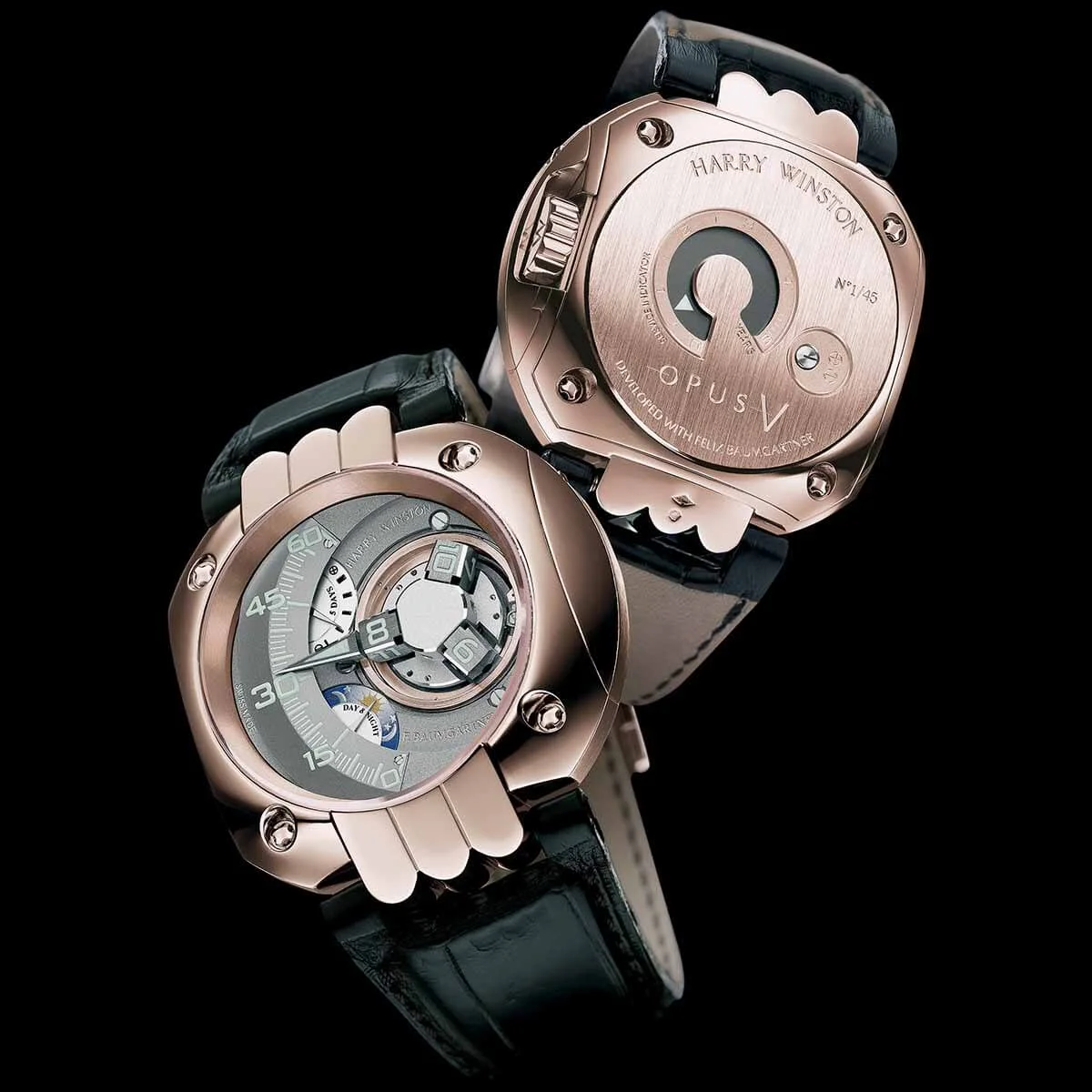
Urwerk describes that feature as a world first.
More importantly, Felix Baumgartner has described Opus 5 as a milestone for Urwerk itself.
Harry Winston exposed the independent brand's work to an audience it had never previously reached.
By this point the Opus project was not just generating strange watches.
It was giving strange watchmakers a very large stage.
Opus 6: Greubel Forsey before Greubel Forsey was enormous
The following year brought another partnership that looks ridiculous in hindsight.
Robert Greubel and Stephen Forsey.
Today, Greubel Forsey exists somewhere around the summit of independent watchmaking.
In 2006, their own company had only been established for about two years.
For Opus 6, Harry Winston and Greubel Forsey produced just six watches.
At the centre was the Double Tourbillon 30°.
One tourbillon cage sits inside another.
The inner cage is inclined at 30 degrees and completes one rotation every minute.
The outer cage rotates every four minutes.
That is an extremely casual way of describing an absurdly complicated mechanical object.
And given where both Greubel Forsey and Harry Winston would eventually take the multiple-tourbillon idea, stopping at two now almost seems restrained.
Opus 9: a conveyor belt made from diamonds
Then came Opus 9 in 2009, developed with movement specialist Jean-Marc Wiederrecht and designer Eric Giroud.
This might be the most perfectly Harry Winston watch in the entire Opus project.
Because Harry Winston essentially made a watch that tells the time using conveyor belts of diamonds.
There is no conventional dial.
Instead, two linear moving chains display the hours and minutes.
Each one carries 33 baguette-cut diamonds, with garnets used as the indicators.
So the same company known as the King of Diamonds managed to make diamonds an actual functioning part of the time display.
It is simultaneously high jewellery and experimental mechanical watchmaking.
Which might be the best summary of Harry Winston's watch division imaginable.
Opus 14: an actual mechanical jukebox
Harry Winston joined the Swatch Group in 2013.
The Opus project continued beyond the acquisition, and in 2015 we reached Opus 14, created with Franck Orny and Johnny Girardin.
By this point everyone involved had apparently stopped pretending they were making normal watches.
Opus 14 is inspired by a 1950s jukebox.
Not merely aesthetically.
The mechanism actually behaves like one.
Inside its enormous 54.7mm case is a stack of record-like discs.
Those discs provide different displays including the date, a second time zone and a Harry Winston star.
Select the function you want and a mechanical arm removes the relevant disc from the stack and moves it into the display position.
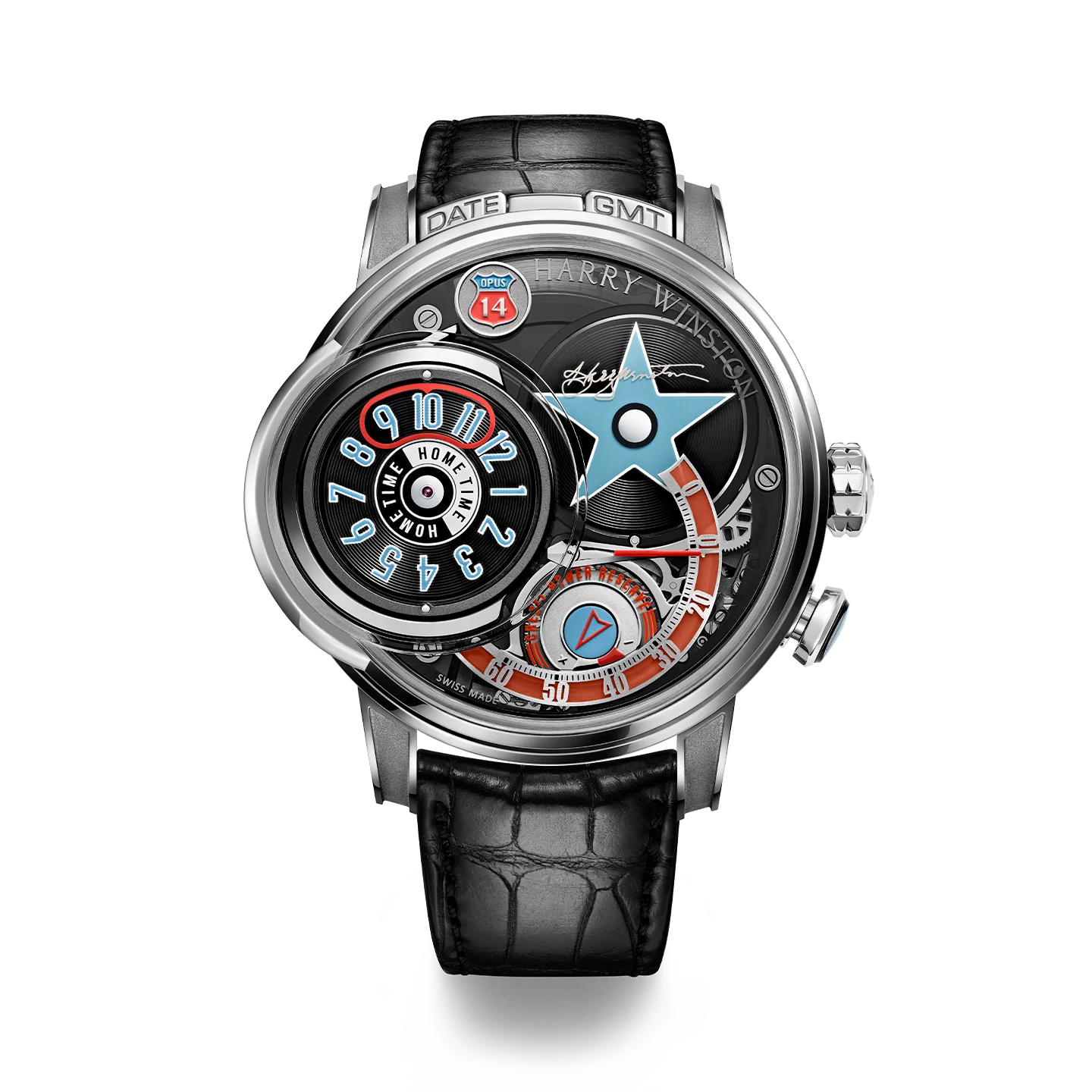
There are even separate power-reserve indications for the watch movement and the jukebox mechanism.
This thing is 21.9mm thick.
Calling it excessive feels insufficient.
It is a tiny mechanical jukebox that happens to tell the time.
And it became the last chapter in the extraordinary Opus series.
Histoire de Tourbillon: what if we just kept adding tourbillons?
While Opus gave independent watchmakers freedom to pursue almost any idea they wanted, Harry Winston launched another series in 2009 with a much narrower brief.
Histoire de Tourbillon.
The question this time was essentially:
How ridiculous can we make a tourbillon?
A tourbillon is already one of mechanical watchmaking's most elaborate and arguably unnecessary complications.
Harry Winston's solution was to keep adding things to it.
More tourbillons.
More axes.
More cages.
More differentials.
More everything.
And they did not exactly start slowly.
Histoire de Tourbillon 1: two is the minimum
The first Histoire de Tourbillon already contained two tourbillons.
Both are inclined at 25 degrees.
Both complete a rotation every 36 seconds, considerably faster than the common 60-second tourbillon.
The watch itself is enormous at around 48mm, with the two regulating systems dominating the upper half of the case.
So this is our starting point.
Number one already has two inclined, fast-rotating tourbillons.
There were another nine editions to go.
Histoire de Tourbillon 4: now add another axis
By Histoire de Tourbillon 4 in 2013, Harry Winston had moved beyond simply increasing the number of tourbillons.
Instead, it started adding axes.
Technically, this one only has a single tourbillon.
Boring.
Except that regulating system sits inside three concentric cages, all rotating at different speeds and orientations.
The inner cage rotates every 45 seconds.
The middle cage every 75 seconds.
The outer cage takes five minutes.
So the balance is effectively tumbling through three dimensions continuously.
It is a serious piece of mechanical engineering presented like some sort of science-fiction fever dream.
And somehow it still was not the most excessive Histoire de Tourbillon.
Histoire de Tourbillon 7: two multi-axis tourbillons
By 2016, Harry Winston had apparently decided that one multi-axis tourbillon was no longer enough either.
Histoire de Tourbillon 7 contains two biaxial tourbillons.
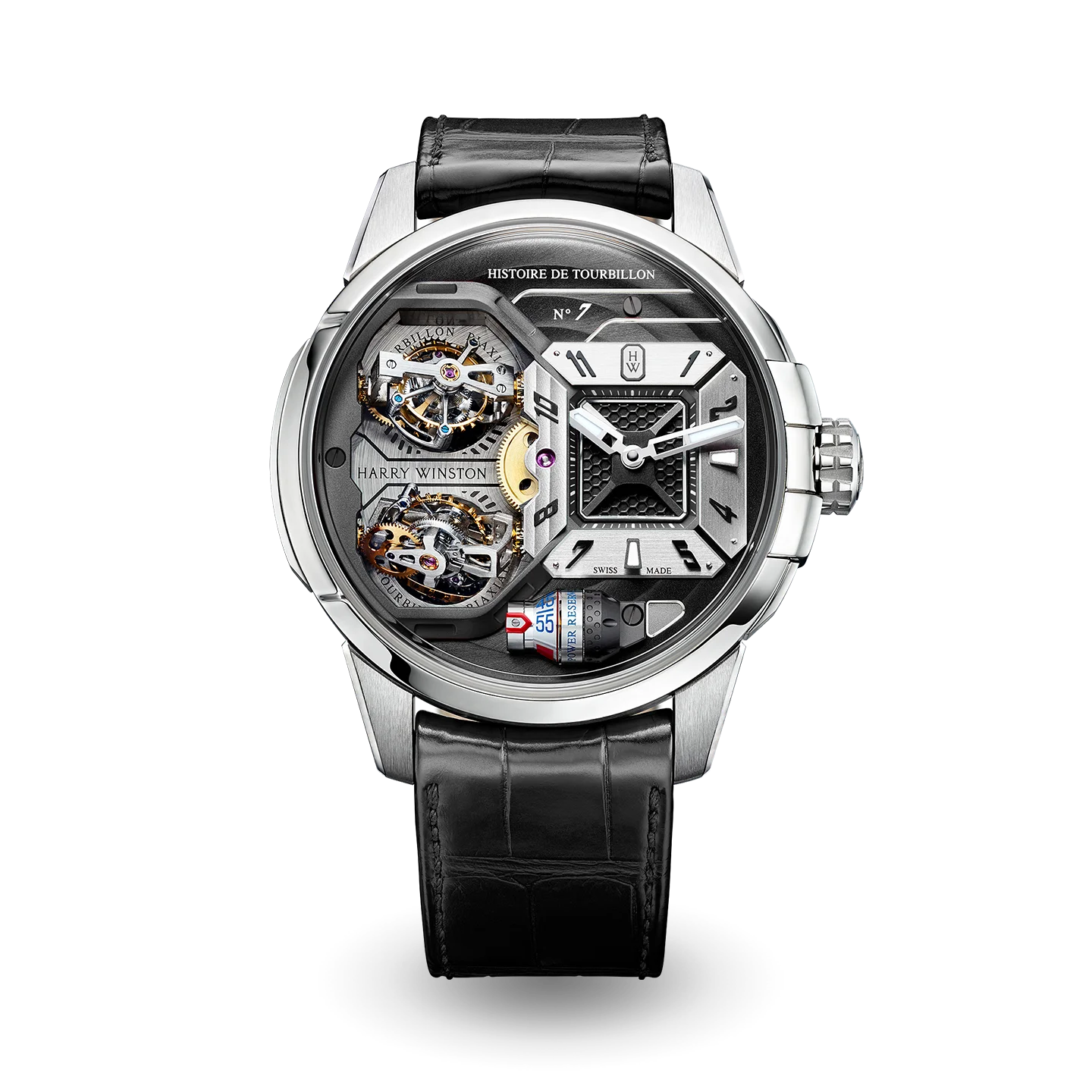
Each has a balance inclined at 30 degrees, with the regulating organs moving through two separate axes.
The outputs of the two systems are then brought together mechanically before being sent to the time display.
The case is 50.9mm across and 17.3mm thick.
At this point, subtlety had left the building several models ago.
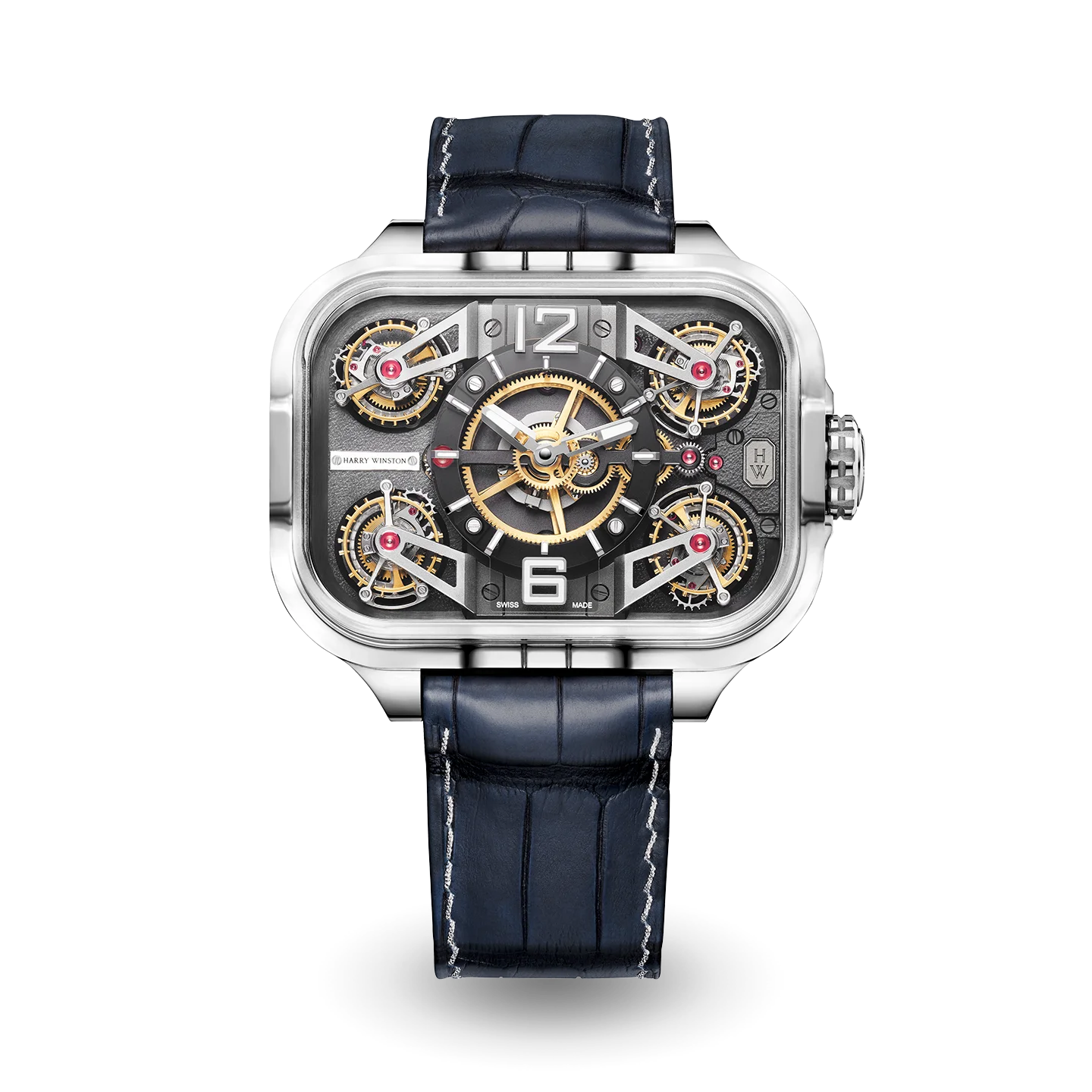
Histoire de Tourbillon 10: four tourbillons
Then, in 2019, Harry Winston reached the tenth and final Histoire de Tourbillon.
The headline is straightforward.
Four tourbillons.
Four separate regulating organs sit in the corners of the movement.
Each completes a rotation every 36 seconds.
Naturally, four independent regulating systems are not going to run in absolutely perfect synchronisation, so Harry Winston uses three differentials to combine and average their outputs before transmitting the result to the time display.
The hand-wound HW4702 contains 673 components.
The case measures approximately 53.3 by 39.1mm and is 17.6mm thick.
This is not quiet luxury.
It looks like somebody asked how many tourbillons could reasonably fit inside a wristwatch and Harry Winston responded by objecting to the word "reasonably".
After ten years, that was where Histoire de Tourbillon ended.
And four tourbillons seems like an appropriate place to stop.
So has Harry Winston become sensible?
Mostly.
Today's broader Harry Winston catalogue still looks much more like what you would expect from one of the world's great jewellery houses.
Diamonds.
Precious metals.
Elaborate dials.
High jewellery that happens to tell the time.
But the strange streak has never disappeared completely.
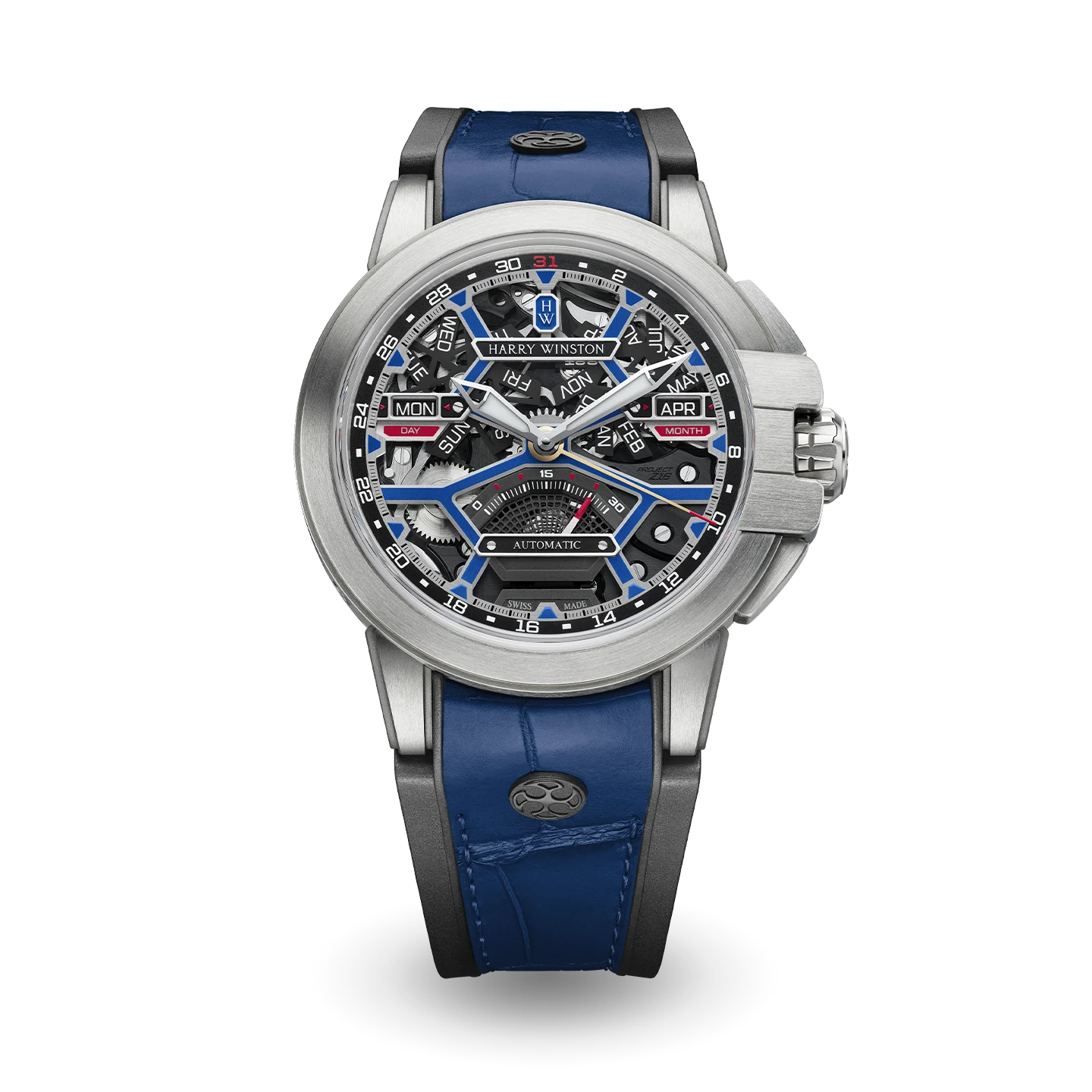
The Project Z16 continued the brand's long-running use of Zalium with an openworked, three-dimensional design, retrograde seconds and the first complete calendar fitted to a Project Z watch.
Then there is the Ocean Tourbillon GMT Worldtimer.
This combines a tourbillon, GMT and world-time functionality inside a 46mm white-gold case.
And because this is Harry Winston, it is also set with 388 baguette-cut diamonds, plus an emerald-cut diamond.
Only five were made.
So no, we are not getting mechanical jukeboxes every year.
Four-tourbillon wristwatches are not exactly standard catalogue fare either.
But Harry Winston has not become boring.
It is still fundamentally a jewellery house.
It just happens to be a jewellery house with one of the strangest watchmaking archives in Switzerland.
And that might make it one of the most overlooked brands in the entire Swatch Group.