
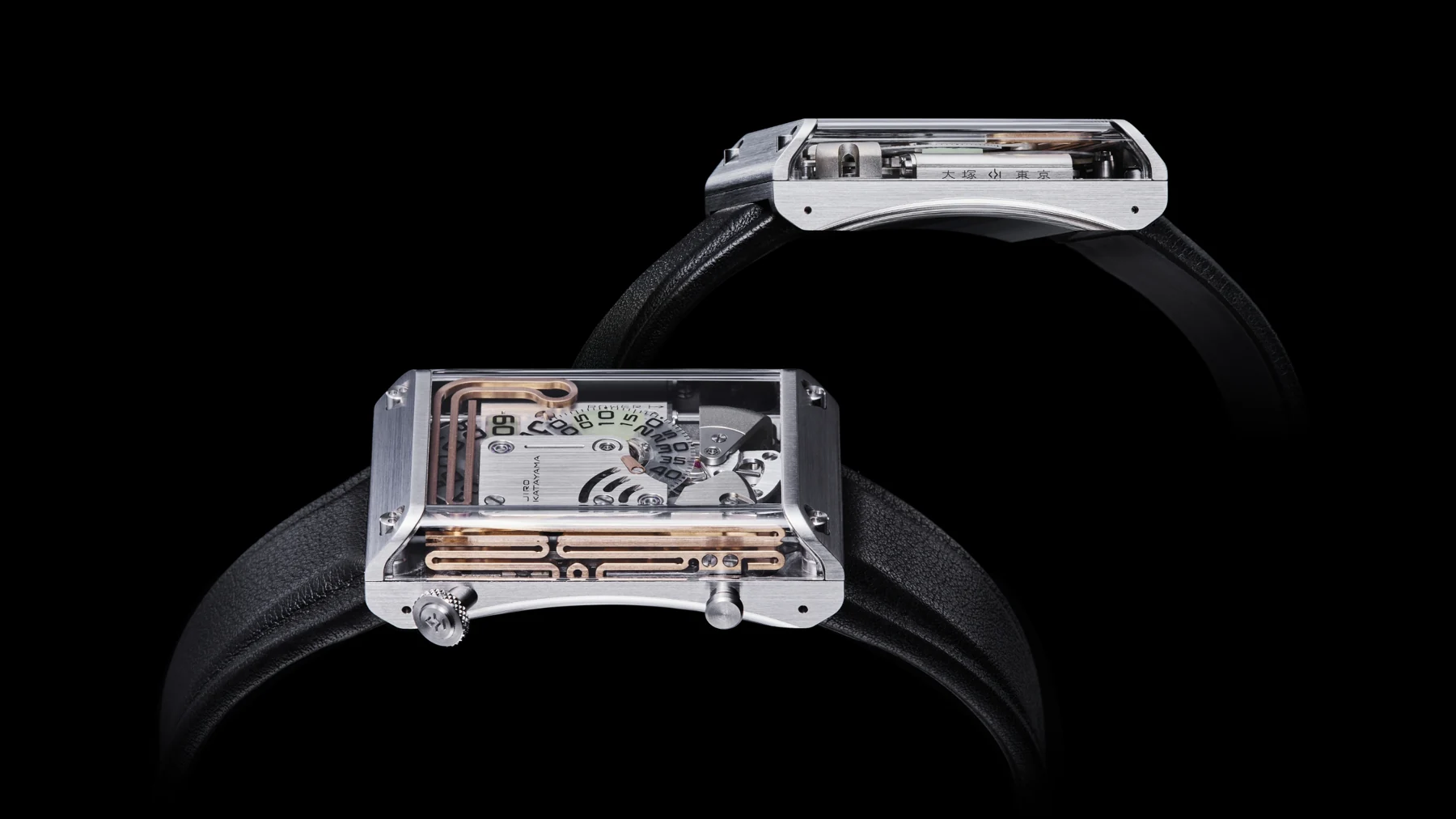
At one end of this story is a roughly US$70 watch that tells the time like an old car odometer. At the other is a mechanical watch with a tourbillon and a tiny hammer that strikes a gong shaped like industrial pipework.
Both come from Japan. Neither comes from Seiko, Citizen or Casio.
Japan's watchmaking giants hardly need an introduction, but they can make it easy to overlook the smaller companies working around them. For the fourth stop on Around the World in 80 Microbrands, I wanted to see what happens beyond those familiar names.
Quite a lot, as it turns out. And the more interesting question soon becomes how five companies from the same country can arrive at such different ideas of what belongs on your wrist.
Future Funk: the future apparently needed more rollers
The best introduction to Future Funk is the KF302 Roller. Three numbered drums turn vertically behind a small window: one for the hours, two for the minutes. Think of an analogue odometer, or the spinning reels of an old slot machine.
Only this one tells you when to leave the pub.
There is even a demonstration mode that sends the rollers spinning before they return to the correct time. It serves no essential timekeeping purpose, but if you have put miniature rolling drums inside a watch, you might as well let people watch them roll.
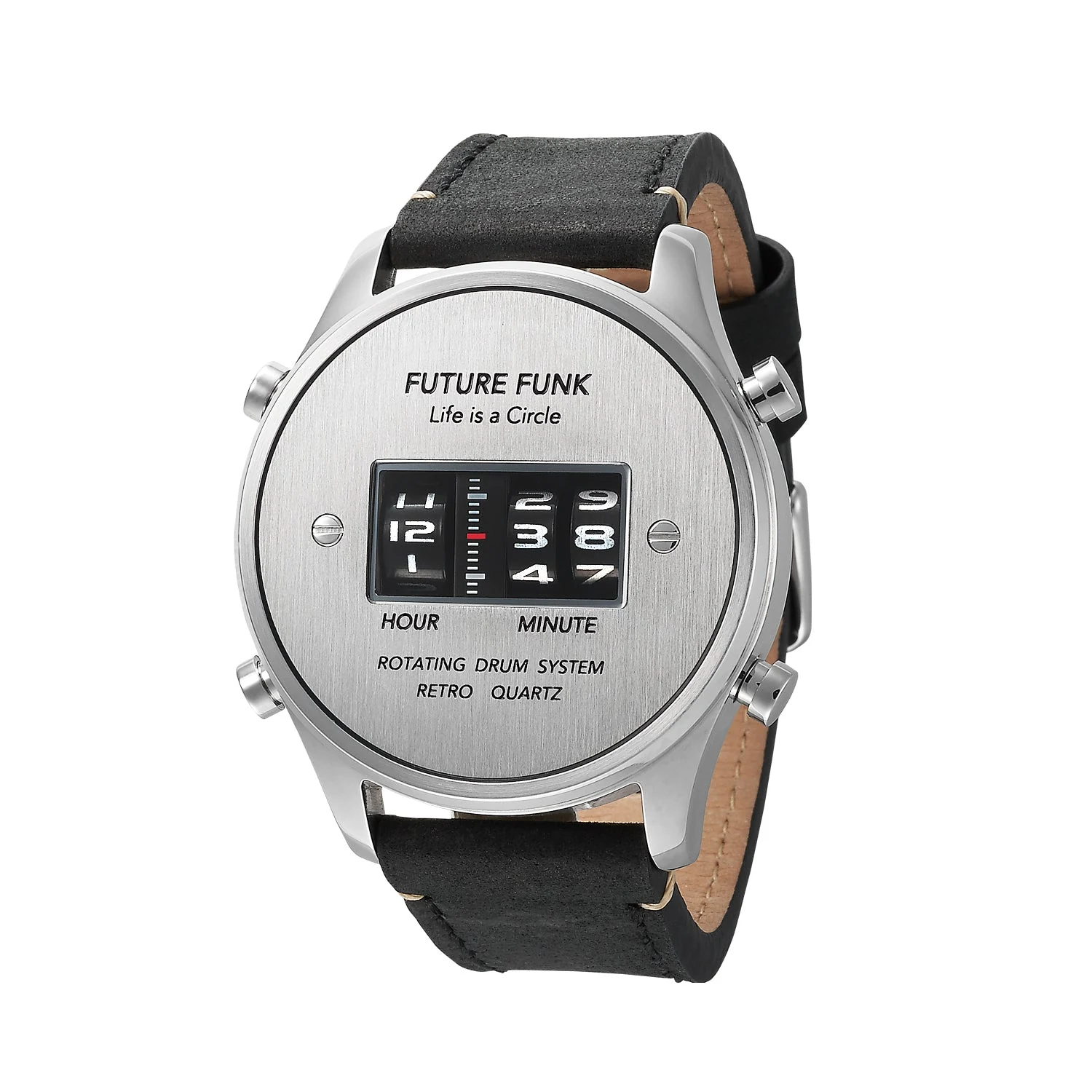
The important detail is that the watch is quartz. The numbers are physical objects moving inside the case, but that doesn't make it an elaborate mechanical complication. Around US$70 was the price level discussed in the original video, which puts this sort of eccentricity within surprisingly easy reach.
Future Funk explicitly draws on the Space Age optimism of the 1970s. You can see it in the FF201 LED, with its chunky case, dark red crystal and glowing digits that appear when you press a button. It is the sort of watch that looks particularly at home in gold tone. Subtlety would almost spoil it.
The KF301 Retrograde takes a different route. A retrograde display moves across an arc, reaches the end and returns to its starting point, rather than travelling endlessly around a circle. In mechanical watchmaking, producing and controlling that return can become an expensive business. Future Funk uses quartz to deliver the display's visual appeal at around US$130.
These are different technical propositions, and there is room to enjoy both. I like that Future Funk starts with the entertaining bit and works out how to make it affordable. A rolling number drum doesn't become less amusing because it needs a battery.
Fukushima Watch Company: a future rooted in a place
Fukushima Watch Company begins with a different question: what might watchmaking help a place become?
The company is based in Odaka, a district of Minamisoma in Fukushima Prefecture. Following the earthquake, tsunami and nuclear disaster in 2011, people were forced to leave homes and communities across affected parts of the region. Rebuilding has involved much more than repairing buildings, and the return of residents has been a long, uneven process.
Founder Masayasu Hiraoka moved to Odaka in 2022. His ambition is to help make Fukushima what the company calls “the Geneva of Japan”. That is a substantial aspiration, but the company describes a patient process: connecting local skills, increasing the work that can be carried out in the region, and eventually encouraging more watchmaking businesses to emerge.
It is an ambition for an industry and a community, beginning with the watches the company can make now.
The first collection, Odaka, makes that connection tangible. Its 36mm automatic watches use Miyota 82S5 movements, with colours drawn from the produce and landscapes around Minamisoma. Broccoli Green, Chilli Pepper Red, Blueberry Blue and Seaweed Black make a fairly memorable alternative to the usual catalogue of blue, black and silver.
The smaller Futaba collection takes its name from another town in Fukushima Prefecture that endured years of evacuation. The company researched the town's earlier landscapes and daily life while considering its future, then translated those ideas into 34mm watches with distinctive two-tone dials.
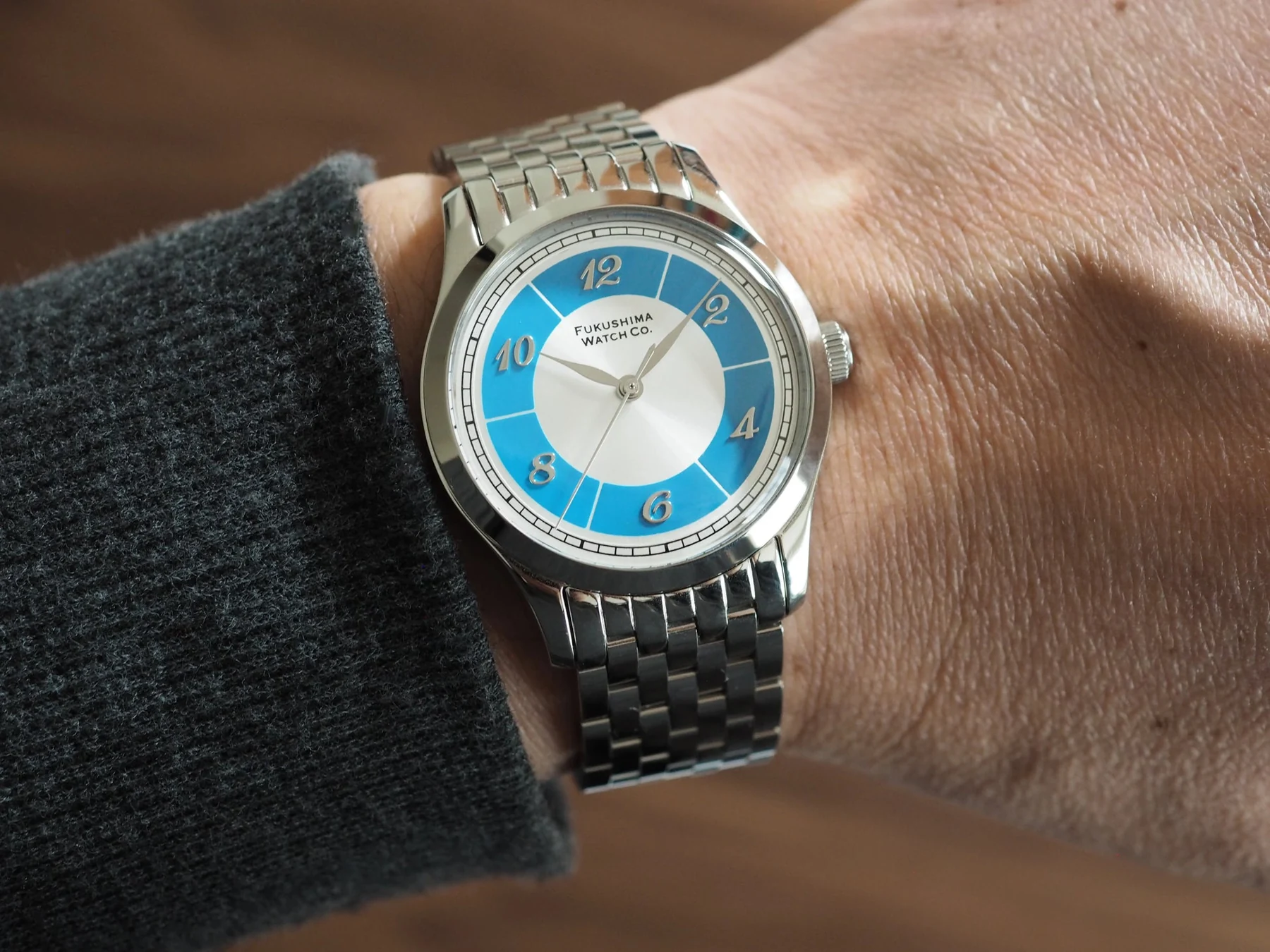
Futaba uses the Miyota 82S0, rather than the Odaka's 82S5. More significantly for the project, the company says a portion of sales supports activities contributing to Futaba's future.
What interests me here is the connection between a watch and the place behind it. The colour names invite someone to learn about Minamisoma. The Futaba collection directs some of its proceeds back towards the town. The longer ambition is to create opportunities for skilled work and a local identity around watchmaking.
The company is clear that this larger future is still being built. Following those first steps is a good reason to pay attention.
TACS: somebody has turned the camera into a watch
With TACS, the starting point is often an object. A clock, a cassette or a piece of architecture supplies the visual idea, and a watch grows around it.
The designs I keep coming back to are the camera-inspired ones. The ATL, or Automatic Twin Lens, takes the most recognisable feature of a twin-lens reflex camera, two large circular elements stacked vertically, and makes it the basis of the dial.
That is a more interesting approach than putting a tiny camera illustration beside the hands. The circles determine how the watch is organised. The surrounding surfaces and camera-like proportions carry the idea across the whole face, while the visible mechanism gives you something moving within it.
There is an appealing overlap here. Cameras and mechanical watches are both objects people can enjoy for the way they are designed and assembled, even when a phone has absorbed much of their everyday usefulness. TACS makes that connection unusually literal.
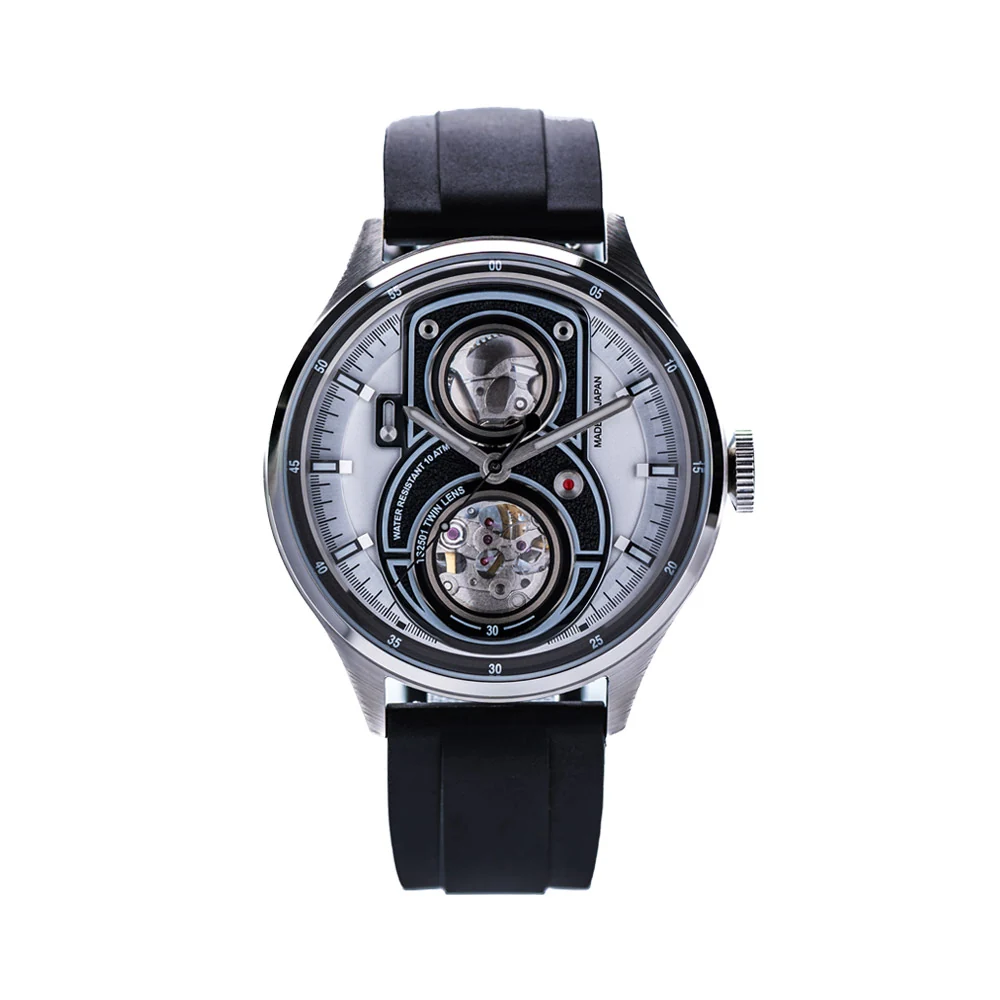
The ATL Lite is the smaller, lighter interpretation of the original ATL. TACS identifies the Ikoflex twin-lens camera as its inspiration. The TS2501A shown here has a Japanese automatic movement and weighs a stated 87g on its rubber strap, though its 42mm width and 15mm thickness mean “Lite” still needs to be understood in the context of this particular family.
It retains the two stacked circular openings and the camera reference while giving the concept a more compact form. The original ATL and the Lite should therefore be treated as distinct versions, rather than interchangeable names for whichever photograph happens to be available.
Then there is the Robotoys collaboration. Selected ATL Lite sets come with a handmade robot watch stand from the Korean craft brand. The robot's job is to hold your watch while you aren't wearing it.
A table can already do that. It just lacks the commitment.
That combination sums up TACS rather well: a familiar object reimagined as a watch, then another object built to look after it. The catalogue is enjoyable because the brand keeps following these ideas further than strictly necessary.
Wancher: moving the craftsmanship beyond the dial
Fukushima Watch Company's ambition looks towards a new regional watchmaking culture. Wancher finds much of its identity in Japanese crafts with a much longer history.
Chief among them is urushi, lacquer derived from tree sap. Artisans apply it in successive layers, allowing it to cure under controlled conditions. The resulting surface can have a depth that makes the colour seem to sit within the material, rather than simply on top of it.
The Dream Urushi Blue is an approachable example. Its 42mm case contains a Miyota 9015 automatic movement, while the dial is hand-lacquered in Echizen. The blue can appear dark and inky or much brighter as the light changes. At around US$470, the interest is concentrated in the surface you spend most of your time looking at.
Wancher's wider range also incorporates gold decoration and shell inlay. Maki-e uses metal powder in lacquer decoration; kinpaku means gold leaf; raden introduces pieces of shell or mother-of-pearl. Those distinctions matter because the different materials and processes produce very different effects.
The Kawari Nuri is the one that particularly caught my attention. Its dial comes from Wajima, where artisans create an elaborate green-and-black marbled appearance. Wancher describes hand-drawn decoration over the lacquer layers, with real gold maki-e details. The result has far more going on than a simple coloured coating.
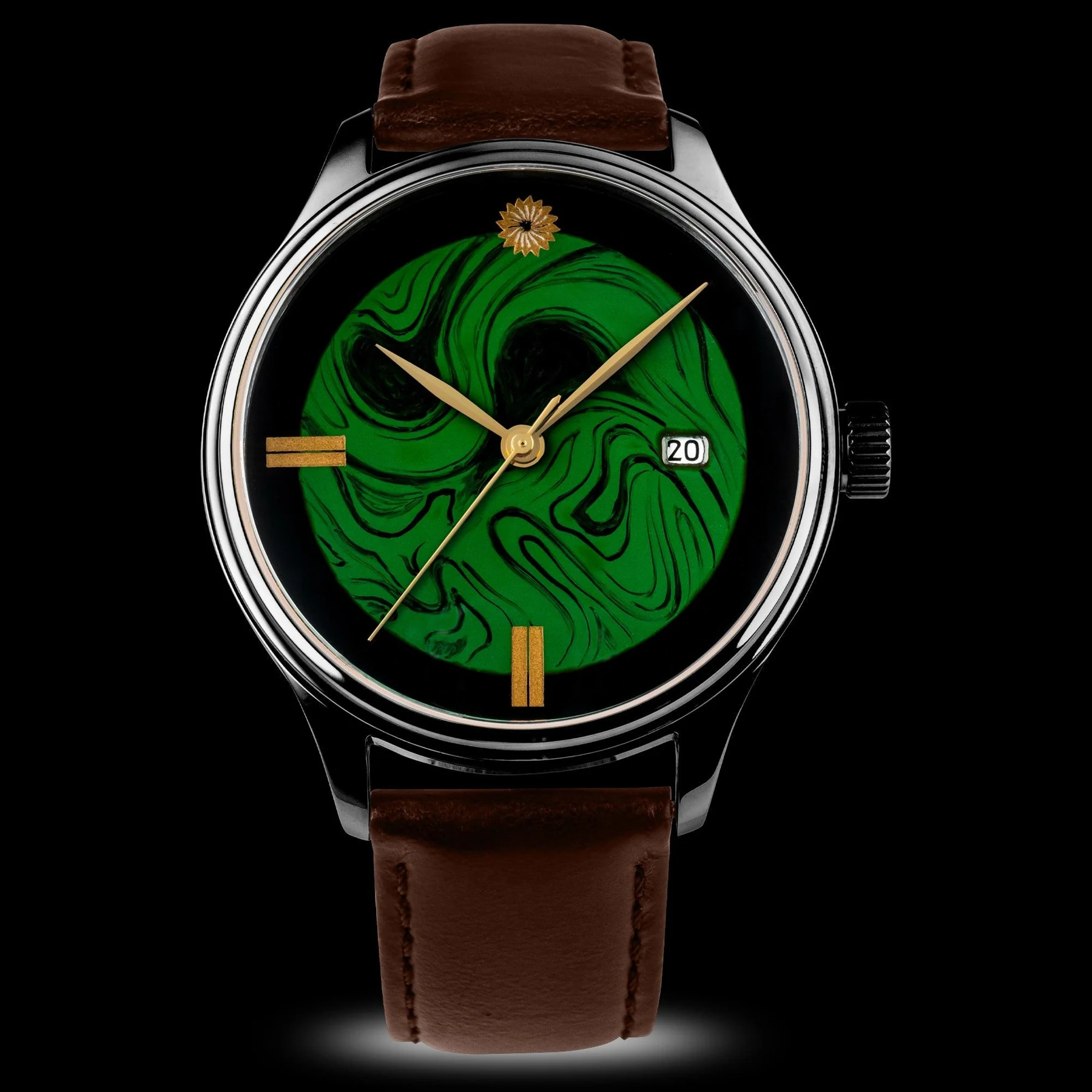
Kawari Nuri watches have been listed from around US$850, but the most unusual development needs to be discussed separately from that starting price. Wancher also worked with an Aizu artisan on a hand-lacquered steel case, finished in a deep red Aka Tamenuri treatment.
In its July 2026 account, the company described just one such case. Wancher called the project a world first; that is its claim, rather than an independently established record. It also shouldn't turn into a claim that every Kawari Nuri has a lacquered case.
What makes the experiment compelling is the change in where the craft lives. A decorated dial stays behind the crystal. Putting lacquer on the case brings it into a part of the watch the owner handles. The Wajima dial and the Aizu case represent different regional contributions, connected through the same small object.
Wancher gives established craft techniques another setting in which to be seen, used and appreciated. Occasionally, that setting is somewhere quite unexpected.
Ōtsuka Lōtec: the machinery is the attraction
For the final brand, we leave affordable eccentricity a considerable distance behind.
Ōtsuka Lōtec was founded by Jiro Katayama, whose product-design and machining background helps explain the industrial character of the watches. Gauges, exposed screws, metal surfaces and visible mechanisms are central to their appeal. They look as though they ought to be monitoring something inside a power station.
The best-known example is the No. 6. Its hour and minute hands share an axis and travel across fan-shaped scales. Each returns to the start when it reaches the end of its range. We encountered the retrograde idea at Future Funk; here the return is produced mechanically.
A Miyota 9015 supplies the base movement, with Ōtsuka Lōtec's own retrograde module handling the unusual display. That arrangement gives a small maker room to develop a distinctive mechanism around an established movement. The result won the Challenge Watch Prize at the 2024 Grand Prix d'Horlogerie de Genève.
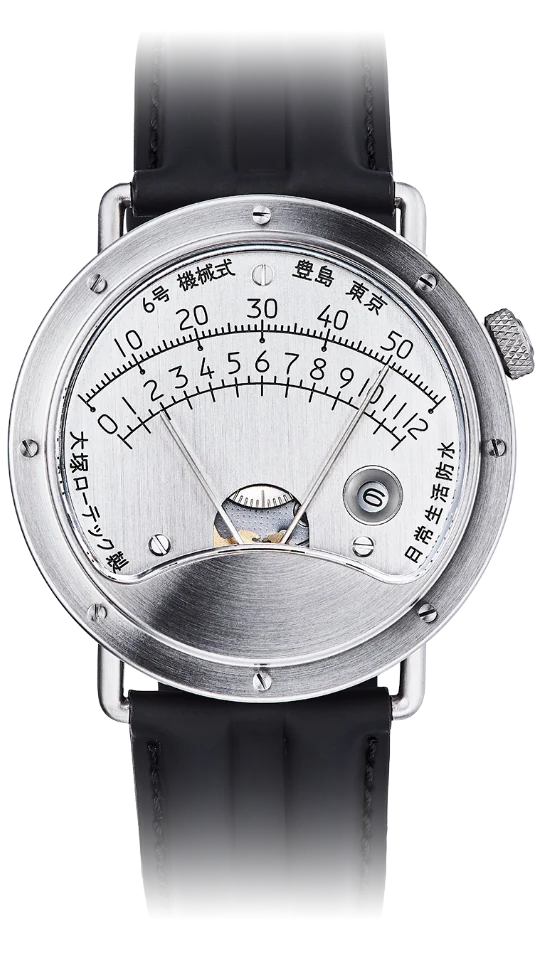
The 2026 No. 8 develops the industrial idea further. A jumping-hour display changes instantaneously at the hour. Beside it, a minute indicator described as a “fader” advances through its range, then returns from 60 to zero through a flywheel-linked mechanism. A seconds disc keeps rotating while the other displays perform their hourly reset.
This is another Miyota-plus-module construction, using the 90S5 underneath the brand's own mechanism. The appeal is watching several movements coincide beneath the crystal, like a miniature piece of equipment completing a cycle.
Then there is the No. 9.
Jumping hours and rewinding minutes are joined by a tourbillon, a power-reserve indicator and an hour strike. A tourbillon carries the regulating assembly in a rotating cage; the power-reserve indicator tells you how much running time remains in the wound spring. The hourly chime adds another way of experiencing the machinery.
At the top of the hour, a tiny hammer hits a pipeline-shaped gong. It is an hour-striking watch, rather than a minute repeater that sounds out the time on request. The gong's shape makes perfect sense alongside the exposed mechanisms and instrument-like displays.
The hand-wound Cal. SSGT is an in-house-developed calibre, a significant departure from putting a display module on a Miyota. That still doesn't mean the brand manufactures every component. Ōtsuka Lōtec identifies some parts taken from the Cal. 6498, including the barrel, as well as specialist bearings supplied by MinebeaMitsumi.
The official Japanese price is ¥17,600,000 including Japanese tax, or ¥16,000,000 excluding tax. That puts us in the six-figure US-dollar territory discussed in the video, though an exact conversion would move with the exchange rate.
We have travelled a very long way from the roller watch. Yet the attraction is still wonderfully immediate: you can watch the hour change, see the minutes rewind and hear the little hammer bring the whole performance to a close.
Interesting is the only requirement
A quartz roller and an elaborate chiming tourbillon make an absurd pair of bookends. Between them are watches connected to the future of a town, the familiar face of a camera and the work of lacquer artisans.
That variety is what I wanted to find in Japan. There is no single appearance, price bracket or degree of mechanical complexity tying these five brands together. Each gives you a different reason to stop and look closer.
There are plenty more waiting in the White Tee Watches brand directory. These five are simply one route beyond the familiar giants.
The roller doesn't need a tourbillon to earn its place here. The tourbillon doesn't need to be affordable. What makes either worth discovering is whether it gives us something interesting to talk about.